The cable jacket is the outer protective layer of a cable, but in a cable assembly, it does much more than cover the conductors. The jacket helps determine how the assembly handles abrasion, chemicals, heat, moisture, movement, and fire-related risk. Choosing the wrong jacket can shorten service life, create installation problems, or leave the assembly vulnerable to its operating environment.
Jacket selection is never a cosmetic detail; it’s part of the engineering decision that affects fit, durability, compliance, and long-term consistency.
Key Takeaways
- Cable jacket material affects durability, flexibility, chemical resistance, heat performance, and fire behavior.
- PVC is a common, cost-effective choice for many general-purpose cable assemblies.
- PUR is a strong option for abrasion, oils, and harsh industrial use.
- TPE is often chosen for demanding flex and motion applications.
- LSZH is important when low smoke and reduced halogen-related fire risk matter.
- The best jacket depends on the environment, movement, temperature, safety requirements, and the overall cable assembly design.
What is Cable Jacket Material?
Cable jacket material is the outer sheath that protects the insulated conductors and internal cable structure. In a cable assembly, that outer layer serves as the first line of defense against abrasion, moisture, heat, chemicals, and handling stress during installation and use.
It’s important not to confuse the jacket with other parts of the assembly. The insulation protects individual conductors, shielding helps control interference, and overmolding protects connector transitions and improves strain relief. The jacket is the continuous outer layer around the cable itself.
Special Offer: Get $100 off your order!
Email [email protected] to get started!
Why Cable Jacket Material Matters in Cable Assemblies
In a standalone cable spec, the jacket is one property among many. In a finished cable assembly, it becomes part of a complete system that includes connectors, shielding, strain relief, routing, and the intended operating environment. A jacket suitable for a static indoor cable will likely fail in a robot, sealed outdoor device, medical product, or high-heat assembly.
This is why cable jacket selection should start with the application, not the material type alone. Engineers need to consider whether the assembly will flex repeatedly, face oils or solvents, operate outdoors, run through heat, or require lower-smoke performance in enclosed spaces.
Common Cable Jacket Materials for Cable Assemblies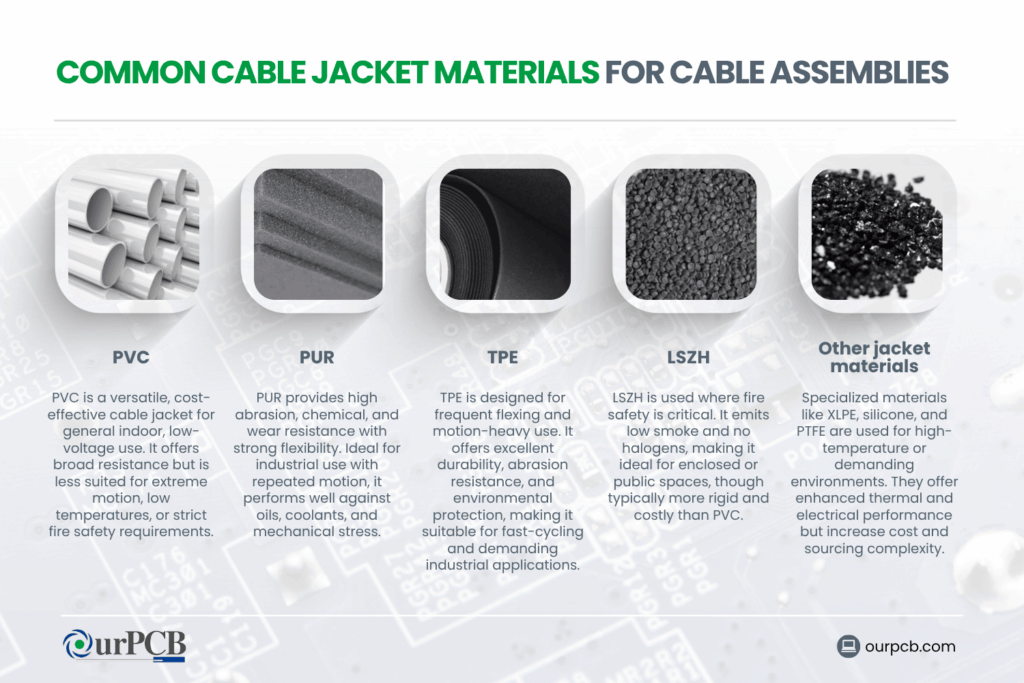
There are several common jacket types used in cable assemblies, and each one suits a distinct set of performance needs. When comparing cable jacket materials, it’s important to look beyond cost alone and consider flexibility, durability, safety, and the conditions the cable must withstand.
| Material | Main Advantage | Best For | Main Drawback |
|---|---|---|---|
| PVC | Cost-effective and versatile | General-purpose indoor cable assemblies | Less suitable for harsh motion or strict fire-safety requirements |
| PUR | Tough, flexible, abrasion- and oil-resistant | Industrial and machinery-related assemblies | Often unnecessary for basic, low-cost applications |
| TPE | Excellent for flex and movement | High-motion, demanding industrial environments | Usually higher-cost than general-purpose options |
| LSZH | Low smoke and zero halogen | Enclosed, public-facing, or safety-sensitive spaces | More rigid and more expensive than PVC |
| XLPE / Silicone / PTFE | Specialized thermal or environmental performance | High-temperature or unusual operating conditions | More niche and not needed for most standard builds |
PVC
Polyvinyl chloride (PVC) is one of the most common cable jacket materials because it’s versatile, widely available, and cost-effective. It offers good general mechanical protection and is often used in indoor, low-voltage cable assemblies for control systems, lighting, packaging, and assembly lines.
PVC also provides resistance to oils, acids, abrasion, sunlight, heat, salt, water, and moisture in many environments. However, it’s not always the best choice for every application, especially where extreme motion, low-temperature flexibility, or strict low-smoke and flame resistance requirements matter.
PVC is usually best for general-purpose, cost-sensitive cable assemblies rather than harsh or highly dynamic environments.
PUR
PUR is a strong choice when a cable assembly needs more abrasion resistance, chemical resistance, flexibility, and durability than PVC can provide. It’s often used in industrial applications such as machinery, food processing, medical equipment, railways, and automotive systems.
It performs well where repeated movement and mechanical stress are part of normal operation. PUR offers strong notch resistance, good low-temperature flexibility, and can be available in flame retardant and halogen-free versions depending on the application.
PUR is a good fit for cable assemblies that must resist oils, coolants, and wear in demanding industrial environments.
TPE
TPE is a thermoplastic material often used where repeated flexing is required. It’s typically selected for cable assemblies that need durable flex performance and strong resistance to environmental factors such as chemicals, temperature variation, and mechanical stress.
Compared with more general-purpose materials, TPE is often favored for motion-heavy applications. This is because it can handle mechanical loads well, offers excellent abrasion resistance, and can be formulated for flame retardant performance.
For cable assemblies exposed to frequent motion, fast cycling, or harsh industrial use, TPE is often the first jacket type to consider.
LSZH
LSZH stands for low smoke zero halogen. It’s used when fire safety is a priority because it produces very little smoke and no halogens when burned. This makes it a strong option for enclosed, poorly ventilated, or safety-sensitive environments.
LSZH is often used in transportation, infrastructure, medical settings, and other public-facing spaces where reducing fire-related risk matters. It’s usually more rigid and more expensive than PVC, so it’s typically chosen for its fire-performance benefits rather than as a general-purpose upgrade.
Other jacket materials
Some applications need more specialized jacket types than PVC, PUR, TPE, or LSZH. Depending on the design, materials such as XLPE, silicone, and PTFE may be used where the cable assembly must withstand higher temperatures or more specialized electrical and environmental demands.
Silicone and PTFE are most often specified for extreme environments, including aerospace applications, high-power industrial equipment, and medical devices where continuous exposure to heat, sterilization, or aggressive media rules out standard thermoplastics.
XLPE is common in energy and automotive wiring where better voltage and thermal performance is needed without the complexity or cost of silicone. These materials tend to add cost and sourcing time, so they're worth specifying only when the application genuinely demands it.
How to Choose the Right Cable Jacket Material
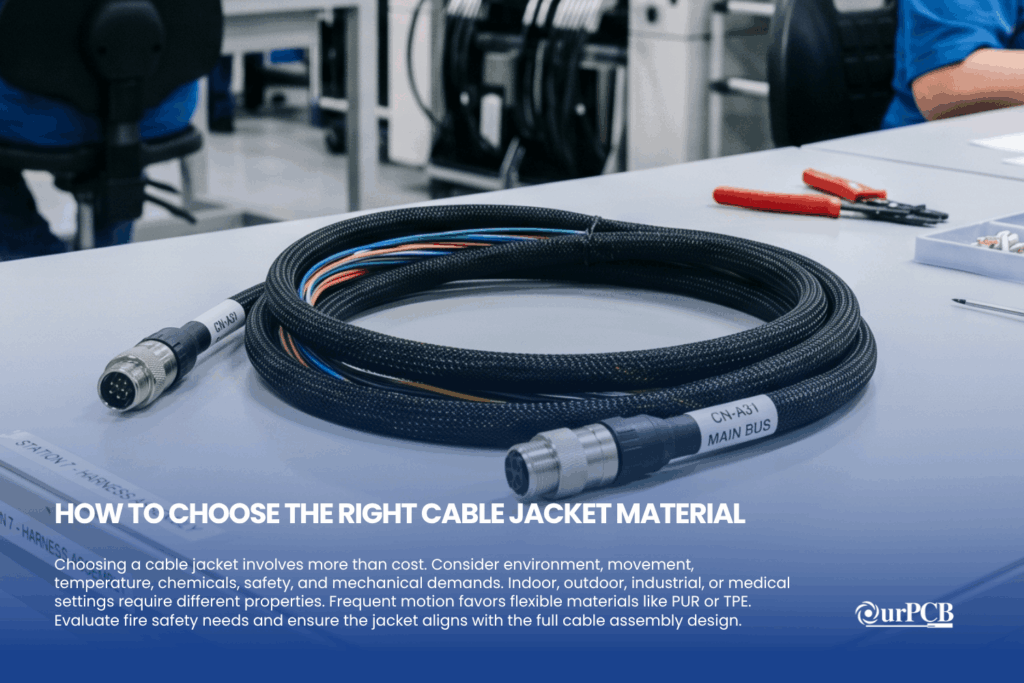
When choosing a cable jacket material, look beyond cost to consider the complete application. The right material depends on the environment, movement, temperature range, safety requirements, and the level of mechanical protection the cable assembly needs.
1. Start with the operating environment
The first question is where the cable assembly will be used. Indoor assemblies often prioritize cost and general durability. Outdoor assemblies may need better resistance to weather and moisture. Industrial environments may introduce oils, chemicals, and abrasion. Medical or lab environments may require cleaner materials, tighter traceability, or specialized performance.
2. Analyze movement
A cable assembly that remains mostly fixed can use a very different material from one that bends constantly. Repeated flexing, routing through moving equipment, or use in robotic systems can quickly expose the limits of a material that was chosen only for price. That’s why materials like PUR and TPE are often considered for harsher motion environments.
3. Check temperature and chemical exposure
Heat, cold, and chemical exposure can narrow the material choice quickly. Some applications face oils, cleaners, fuels, or other aggressive substances. Others need the assembly to remain flexible in colder conditions or stable at elevated temperatures. That’s why jacket material selection should always be tied to actual environmental requirements instead of assuming a common material will be good enough.
4. Review fire and safety requirements
In some applications, the jacket material is strongly influenced by fire safety expectations. This is especially true in buildings, enclosed spaces, and installations where smoke, toxicity, or corrosive byproducts are a concern.
5. Fit the jacket to the full assembly design
The best jacket is the one that works with the full assembly, not just the material comparison chart. Connector type, strain relief, shielding, overmolding, routing path, and expected service life all affect what will actually perform well in the field. Jacket selection should always be considered as part of the complete design.
Getting the Right Cable Jacket Material for Your Cable Assembly Project
Choosing the right jacket material early ensures your cable assembly performs consistently from prototype to production. By considering the environment, movement, and safety requirements alongside connector and shielding decisions, you build in reliability from the start.
At OurPCB, we build custom cable assemblies for demanding applications across the industrial, medical, and renewable energy sectors. Our ISO-9001 certified process supports a wide range of jacket materials, connector types, and shielding options – all verified with 100% continuity and mechanical testing. This integrated approach makes it easier to match every component to your specific performance and production needs.
If you need help choosing the right jacket for your application, get a quote and let our team review your requirements.
Cable Jacket Material for Cable Assemblies FAQs
What is the best cable jacket material for cable assemblies?
There's no single answer – it depends on the environment, movement, temperature, chemical exposure, and fire requirements. That said, PVC covers the majority of general-purpose indoor builds, while PUR or TPE become the better choice once abrasion, oils, or significant motion are involved.
Can I mix jacket materials across different cables in the same assembly?
Yes, and it's common in multi-cable or hybrid assemblies where individual cables serve different functions or run through different environments. The key is to make sure the jacket choices are specified clearly in the BOMs and drawing package so the manufacturer builds consistently across runs.
How does jacket material affect lead time or cost?
PVC and PUR are widely stocked and have short lead times for most builds. TPE and LSZH may require more sourcing time depending on the configuration. Specialist materials like silicone or PTFE can add meaningful lead time and cost, so they should be confirmed early in the project rather than introduced at the prototype-to-production transition.
Does jacket material need to be re-specified when scaling from prototype to production?
Not usually, but it's worth reviewing. Material availability at volume, supplier consistency, and compliance requirements can all affect the right choice at scale. If the prototype used a less common material, confirming volume availability before production commitment avoids delays.
What compliance standards affect jacket material choice?
RoHS and REACH restrict certain substances in cable materials, which affects PVC formulations in particular. LSZH is often specified for EN 50575 compliance in building wire applications in Europe. UL ratings (such as UL 94 flame ratings) affect which materials qualify for specific installation environments in North America. Your manufacturer should be able to confirm compliance coverage for the chosen material.
Can OurPCB advise on jacket material if I'm not sure what's needed?
Yes. If you share the application details – environment, movement, temperature range, any chemical exposure, and installation context – our team can review the requirements and recommend the right jacket material as part of the quoting process.
Back to Top: Cable Jacket Material for Cable Assemblies | How to Choose the Right Option
Special Offer: Get $100 off your order!
Email [email protected] to get started!