When you’re looking for a wire harness supplier in China, you’re usually trying to answer a practical question: what actually happens inside the factory, and how do you know the end product will be reliable? A modern China wire harness factory does far more than cut wires and attach connectors. The factory’s job is to convert schematics and bills of materials (BOMs) into a repeatable, testable, and traceable assembly that installs cleanly in the final product.
OurPCB is a China-based manufacturer of custom wire harnesses and cable assemblies, with service coverage that also includes PCB manufacturing and assembly. We’ll cover each step of what a China wire harness factory does and how to select the correct factory for your wire harness needs.
Key Takeaways
- Chinese wire harness factories usually work from customer designs, schematics, and BOMs rather than working from generic off-the-shelf products.
- Production is typically a mix of automation for cutting, stripping, and some crimping, and manual assembly for routing, taping, insertion, and finishing.
- Standards such as IPC/WHMA-A-620 and traceability programs such as Underwriters Laboratories' (UL's) wiring harness program help buyers judge process maturity and quality.
- China’s strength is not only cost. You get supplier density, export experience, scalable production, and the ability to move from prototype to full production quickly.
What does a Wire Harness Factory Actually do?
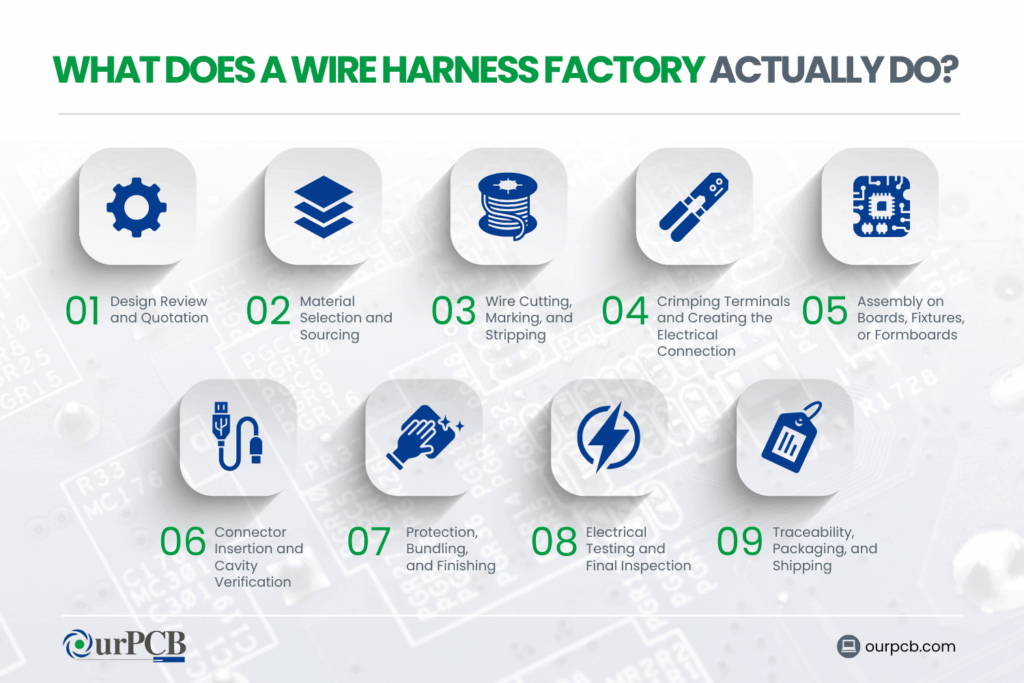
A wire harness factory builds organized electrical assemblies that carry power and signals between components. In practice, that usually means taking a customer’s design files, confirming manufacturability, sourcing approved parts, preparing wires to exact lengths, terminating them correctly, assembling them into the required geometry, and testing the final assembly before shipment.
Therefore, harness factories are usually better understood as process-driven manufacturers rather than as sellers of generic finished goods.
Step 1: Design Review and Quotation
The factory reviews drawings, schematics, and BOMs upfront to catch design and sourcing issues before production starts. This step matters because wire harnesses are custom builds, and minor errors in pin-out, orientation, or branch length can make a harness unusable. Engineering sources say that early design decisions are especially important because they commit about 75% of the manufacturing cost during the design phase. Errors caught late can also force rework at the final test, slowing production and increasing costs.
Step 2: Material Selection and Sourcing
After design confirmation, the factory sources the required materials. That includes wires, insulation type, terminals, connector housings, seals, sleeves, labels, and protective materials. Some projects are fully factory-sourced, while others require customer-approved part numbers or customer-supplied components.
UL’s broader wire and cable services and recognition programs exist precisely because material performance, compliance, and downstream certification can all depend on using the right components and compounds.
Step 3: Wire Cutting, Marking, and Stripping
After materials arrive, wire preparation begins. Modern factories often automate this step. Machines cut wires to exact lengths, strip insulation to specified dimensions, and may also mark or label individual circuits. This automation improves speed and consistency, especially on medium- and high-volume work.
Even here, the process still depends on control. If strip lengths are wrong or strands get nicked during stripping, assembly may not reveal the problem, but it can still weaken the final connection. That’s why this stage is more important than it looks: it sets up everything that follows.
Step 4: Crimping Terminals and Creating the Electrical Connection
Crimping is one of the most critical steps in the entire manufacturing flow. The goal isn’t simply to attach a terminal, but to create a stable electrical and mechanical connection between the conductor and the contact. If the crimp is too loose, too tight, misaligned, or poorly formed, the harness may fail under vibration, heat, or repeated use.
This is one reason the certification IPC/WHMA-A-620 matters so much in the industry. The Wiring Harness Manufacturers Association describes it as the only industry-consensus standard for requirements and acceptance of cable and wire harness assemblies, and it’s used to support correct construction and quality evaluation and expectations.
Step 5: Assembly on Boards, Fixtures, or Formboards
After preparing and terminating individual wires, workers place them onto a harness board or fixture that reflects the final assembly's intended shape. This stage is where the harness takes on its real geometry. Branch points, lengths, tie-downs, and routing paths are laid out so that the finished assembly can fit the final product without strain or confusion.
Factories continue to perform this step manually, despite automated upstream wire processing. Complex harnesses often need human judgment for routing, taping, breakout control, and bundle organization, especially when the harness must fit around physical constraints in the final product.
Special Offer: Get $100 off your order!
Email [email protected] to get started!
Step 6: Connector Insertion and Cavity Verification
After routing, the terminated wires are inserted into connector housings according to the required pin-out. Secondary locks, seals, or gaskets might also be added, depending on the design. This is another step where small errors can become expensive, because a harness can look visually neat while still having one cavity wrong.
Good factories control this with cavity charts, work instructions, operator training, and verification steps. WHMA’s operator training materials specifically emphasize acceptance criteria and workmanship requirements, which shows how much industry practice depends on trained execution rather than on equipment alone.
Step 7: Protection, Bundling, and Finishing
Wire harnesses are not only about making electrical connections. They also have to survive handling, installation, movement, and the operating environment. That is why factories add protective materials such as tape, sleeving, conduit, heat shrink, and strain relief features where required by the design.
The exact protection depends on the use case. A harness in a controlled enclosure may mainly need organization and abrasion resistance, while a harsher environment may demand more sealing, stronger protective layers, or a different assembly type altogether. OurPCB’s own cable assembly guidance draws a useful distinction here: wire harnesses focus on organizing wires, while cable assemblies usually add more robust outer protection for harsher conditions.
Step 8: Electrical Testing and Final Inspection
A serious harness factory doesn’t stop at visual inspection. Continuity and errors like opens, shorts, and wrong connections are tested on final assemblies. Depending on the application, further checks may include insulation-related tests or additional validation of connection quality.
Testing is where process discipline becomes visible. It confirms whether the physical build actually matches the intended electrical design. In high-reliability applications, this final stage is one of the clearest indicators that the factory is operating with control rather than just assembling by appearance.
Step 9: Traceability, Packaging, and Shipping
After testing, the team packages the harness for storage, transport, and installation. Poor packing can deform larger harnesses, damage terminals, or create handling confusion at the customer site. Good factories therefore label by part number, revision, quantity, and batch.
Why do so Many Buyers Source Wire Harnesses from China?
Many buyers still assume that the reason for sourcing wire harnesses from China is due to labor costs alone, and while labor costs are a key driver in wire harness production, that’s too narrow-minded. Harness production remains labor-intensive because routing, breakout control, taping, and connector insertion are difficult to automate completely. China has strong access to wire processing equipment, component suppliers, export logistics, and large-scale manufacturing ecosystems, which makes it well-suited to both prototype and production work.
What Quality Standards Matter Most When Choosing a Chinese Wire Harness Factory?
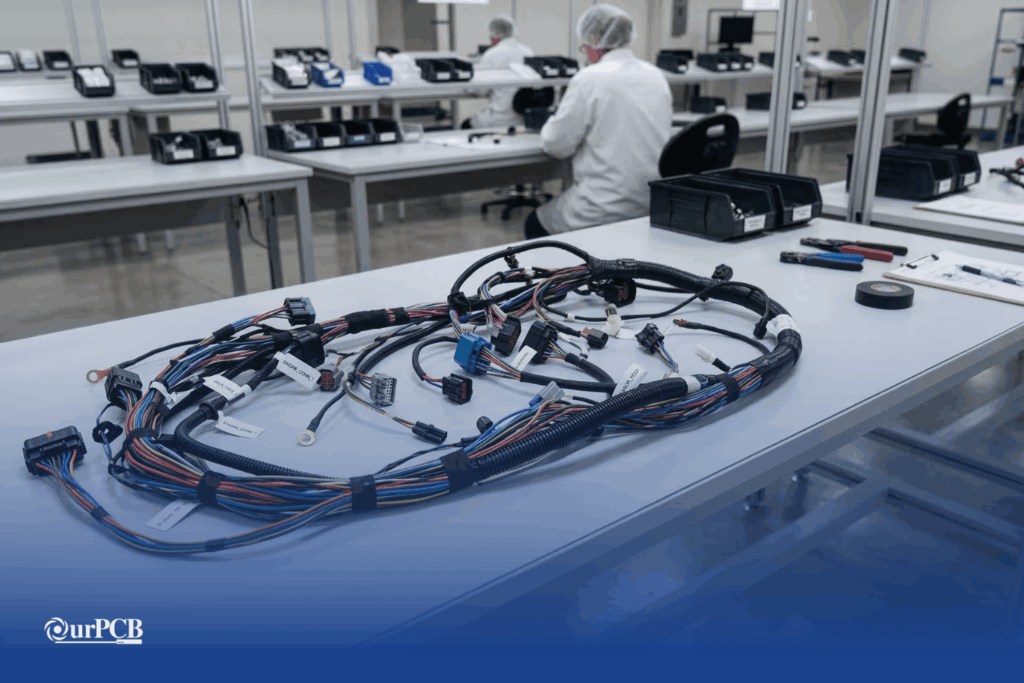
For most buyers, the two most important categories are quality standards and traceability/compliance controls. IPC/WHMA-A-620 is central on the quality side because it defines requirements and acceptance criteria for cable and wire harness assemblies. WHMA explicitly positions it as the industry-consensus benchmark.
On the compliance side, traceability becomes especially important when wires and harnesses move through multiple suppliers or off-site assembly locations. UL designed its traceability program for that exact problem. It helps connect the wire source, harness producer, and final assembly environment in a way that supports accountability.
For buyers in regulated or high-performance sectors, those two themes often matter more than generic marketing claims. A factory that can explain its quality criteria, operator training, test process, and material traceability usually tells you more than one that only promises “high quality.”
What Should Buyers Check Before Choosing a Chinese Wire Harness Factory?
The smartest thing you can do is ask process questions instead of only asking price questions. You want to know whether the factory can review drawings properly, control substitutions, explain its crimp acceptance criteria, test every harness or only samples, and maintain traceability through sourcing and shipment. Those questions line up closely with how industry bodies and manufacturing tool providers describe good harness production practices.
It also helps to check whether the supplier’s public positioning matches your project type. For example, OurPCB presents itself as a China-based manufacturer of custom wire harnesses and cable assemblies, highlighting use cases including automotive, electric vehicles, and robotics, while also offering integrated PCB-related services. That makes it more relevant for buyers who want a broader electronics manufacturing partner, not just a standalone assembly shop.
Build Your Next Wire Harness with OurPCB
If you need a supplier that can support custom wire harnesses, cable assemblies, and PCB-related manufacturing under one roof, OurPCB is a China-based manufacturing partner for exactly that. Whether you’re building for automotive, industrial, robotics, or other electronic applications, working with one partner across more of the assembly process can make quoting, prototyping, quality control, and scaling-up easier to manage. Explore OurPCB’s custom wire harness capabilities and request a quote for your next project.
FAQs on China Wire Harness Factory Work?
Why is IPC/WHMA-A-620 so important in wire harness manufacturing?
IPC/WHMA-A-620 is important because it gives the industry a shared standard for requirements and acceptance of cable and wire harness assemblies. WHMA describes it as the industry-consensus standard, and it helps manufacturers, OEMs, and inspectors align on what acceptable workmanship looks like.
Can a factory automate the entire wire harness production process?
Not usually. Automation is very effective for tasks like cutting, stripping, crimping, and some guided production steps, but many harnesses still rely on skilled manual work for routing, insertion, bundling, and finishing.
Why does traceability matter so much for wire harness sourcing?
Traceability matters because wire harnesses often involve multiple materials, multiple processing steps, and international supply chains. UL’s traceability program exists to connect the wire source, the harness producer, and the final assembly process. This reduces uncertainty for off-site or multi-location product builds.
Back to Top: What does A China Wire Harness Factory do?
Special Offer: Get $100 off your order!
Email [email protected] to get started!