Choosing a cable assembly manufacturer is not just about finding the lowest quote. It’s about finding a partner that can meet your technical requirements, maintain quality, support your schedule, and scale with your product over time.
A poor-fit supplier can create delays, inconsistent builds, field failures, and unnecessary rework. The right supplier helps you move faster, reduce risk, and improve product reliability from prototype through production.
At OurPCB, we've supported over 2,500 global customers with custom cable assemblies, wire harnesses, and integrated electronics manufacturing, from prototype to full production. If you’re comparing suppliers for an upcoming project, this guide will help you focus on the factors that matter most.
Key Takeaways
- Start with your application requirements before comparing suppliers.
- Look for a manufacturer with relevant engineering, testing, and production capability.
- Certifications matter, but process control and traceability matter too.
- Lead time, sourcing transparency, and communication can affect project success as much as price.
- The best supplier is the one that fits your product, quality expectations, and long-term production goals.
Special Offer: Get $100 off your order!
Email [email protected] to get started!
How to Choose a Cable Assembly Manufacturer | Guide Summary
| Area | What To Check | Why It Matters |
|---|---|---|
| Define requirements | Electrical, mechanical, environmental, and volume needs. | Prevents mismatched quotes and helps suppliers assess fit accurately. |
| Match application experience | Experience in your product type, industry, and performance requirements. | Reduces mistakes and improves design, compliance, and reliability. |
| Customization and engineering support | Materials, shielding, connectors, strain relief, sealing, labeling, and prototype support. | Ensures the assembly is designed for real-world performance, not just basic buildability. |
| Certifications and compliance | Relevant certifications, quality standards, and regulatory fit. | Confirms that the supplier can meet quality and industry requirements. |
| Manufacturing capability | Equipment, production methods, capacity, flexibility, and process control. | Shows whether the supplier can build consistently and scale with demand. |
| Quality control and testing | Inspection processes, test methods, traceability, and nonconformance handling. | Improves repeatability and lowers the risk of defects or field failures. |
| Sourcing and lead times | Material sourcing, backup options, stock status, and lead-time breakdown. | Helps prevent delays and supply chain disruptions. |
| Total value | Quote scope, hidden costs, quality, support, and long-term reliability. | Prevents a low initial price from becoming a high total cost due to quality or delivery issues. |
| Communication and support | Responsiveness, technical clarity, account support, and issue handling. | Strong communication makes projects smoother and reduces execution risk. |
| Proof and validation | Samples, test reports, certificates, references, and production evidence. | Verifies claims and gives confidence before committing. |
Start with your cable assembly requirements
Start by defining exactly what your cable assembly needs to do before comparing manufacturers. A clear requirements package helps suppliers quote more accurately and reduces the risk of receiving proposals that look similar on the surface but are based on very different assumptions.
Document the key technical details early, including wire gauge, voltage, current, connector types, shielding, cable length, routing constraints, flex needs, and any environmental exposure such as vibration, moisture, chemicals, heat, or outdoor use.
It’s also important to define the commercial side of the project. Decide whether you need a prototype, pilot run, or ongoing production, and whether the supplier will work from a finalized drawing package or help refine a pre-existing design. Some manufacturers are better suited to low-volume development work, while others are stronger in repeat production at scale. The more complete your input package is, the easier it is to identify a supplier that truly fits your project needs.
Look for experience that matches your application
Look for a cable assembly manufacturer whose experience matches your application. Not every supplier is the right fit for every project, and experience matters most when it aligns with your product type, industry, and performance requirements.
A manufacturer that works mainly with industrial equipment may not be the best choice for medical, automotive, or high-flex robotic applications, where standards, documentation, and reliability demands can differ significantly. A supplier that understands your market is more likely to ask the right questions early and help prevent costly issues later.
Evaluate customization and engineering support
This is where engineering depth becomes important. The right partner should be able to do more than build-to-print. They should review your design for manufacturability, recommend better material or connector options where needed, and help balance cost, durability, and lead time.
A good manufacturer should be able to support decisions around:
- conductor type
- insulation and jacket materials
- shielding and armoring
- connector compatibility
- overmolding or strain relief
- sealing and environmental protection
- labeling and traceability requirements
Engineering support is especially valuable when your assembly must perform in a demanding environment or meet a tight form factor. The right supplier should be able to explain why a certain material, connector, or build method is better suited for your application, instead of simply quoting the cheapest available option.
Check certifications and compliance requirements
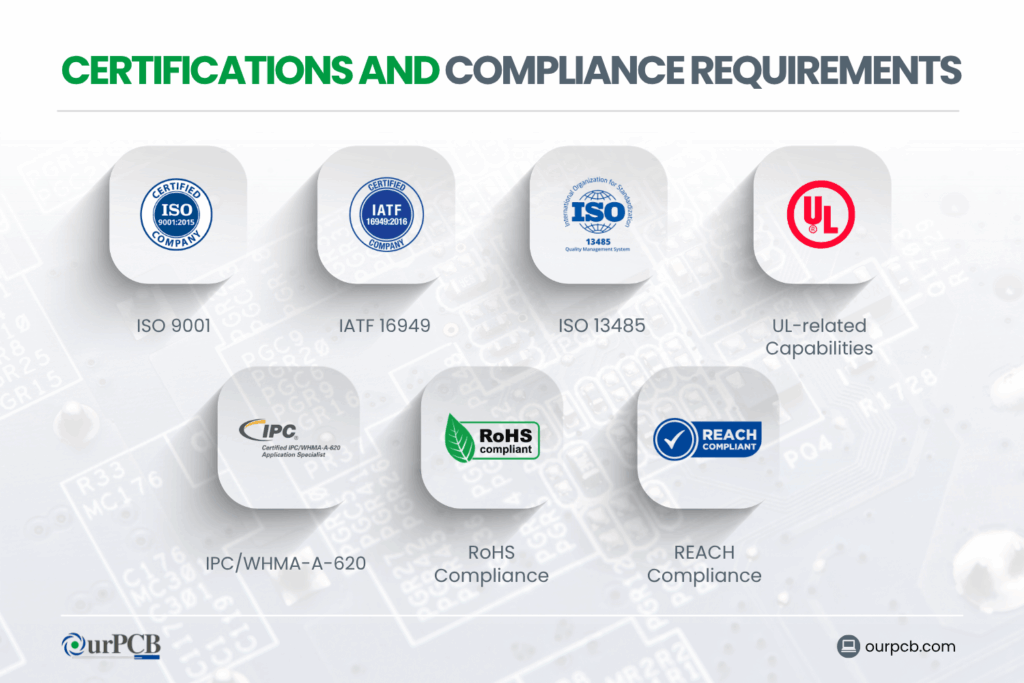
Certifications are an important screening tool. They show whether a manufacturer has formal systems in place and whether they are familiar with regulated quality requirements.
Depending on your market, common certifications to review may include:
| Certification / Compliance | What It Is |
|---|---|
| ISO 9001 | A general quality management standard focused on consistent processes, documentation, and continual improvement. |
| IATF 16949 | An automotive quality management standard for manufacturers serving the automotive industry. |
| ISO 13485 | A quality management standard designed for medical device manufacturers and related suppliers. |
| UL-related capabilities | The ability to support safety-related electrical requirements, certifications, or recognized components. |
| IPC/WHMA-A-620 | An industry workmanship standard for cable and wire harness assembly quality and acceptance criteria. |
| RoHS compliance | Compliance with restrictions on certain hazardous substances in electrical and electronic products. |
| REACH compliance | Compliance with chemical substance regulations covering the use and reporting of certain materials. |
The key is not just whether a logo appears on a website. You want to know whether the certification is current, whether it applies to the actual manufacturing site, and whether it supports the type of assembly you need.
Review manufacturing capability
A supplier may sound capable during sales discussions but still lack the equipment, staffing, or process discipline to support your actual program. That’s why manufacturing capability needs to be reviewed in practical terms.
Ask how the assemblies are produced and managed:
- Are key steps manual, semi-automated, or automated?
- How are wires processed, terminated, inspected, and tested?
- Can the manufacturer handle custom routing, overmolding, high-mix production, or repeat OEM runs?
Audit quality control and testing processes
A cable assembly can pass a visual check yet fail in the field, which is why you must audit the supplier's entire quality process – from inspection and testing to traceability – and not just the sample part.
- Visual pass doesn't equal quality pass: A cable assembly can look correct and still fail in use. The supplier's quality system matters as much as the sample itself.
- Ask about end-to-end quality coverage: Find out how quality is managed from incoming material checks through in-process controls to final inspection.
- Check what tests they can run: Confirm they can carry out the right tests for your assembly, such as continuity, insulation resistance, hi-pot, functional, or pull-force testing.
- Confirm traceability and documentation: A reliable supplier should have documented test procedures, inspection criteria, and material traceability for every order.
- Understand how defects are handled: Ask how nonconforming parts are identified, isolated, root-caused, and prevented from recurring.
- Look for repeatable processes, not just error detection: Strong QC isn't only about catching mistakes; it's about building a system that delivers consistent results every time.
Assess sourcing, lead times, and supply chain risk
A quote only matters if the supplier can source parts, build on time, and deliver consistently. Ask where their key materials and connectors come from, whether backup options are available, and whether any sourcing risks could affect production timelines or quality standards.
Lead times should be clear and realistic. Instead of accepting one broad estimate, ask what could affect delivery, such as material availability, tooling, prototyping, approvals, or scheduling. A dependable manufacturer should be able to explain what is in stock, what may take longer, and how they manage supply disruptions.
Compare the total value, not just the quote
Price matters, but the cheapest quote is not always the best value. A lower upfront cost can lead to higher expenses later on due to quality issues, delays, rework, or poor support.
When comparing suppliers, look at the full picture. Consider engineering support, manufacturing consistency, lead time reliability, quality performance, communication, and what is actually included in the quote. A good manufacturer should be transparent about costs such as tooling, sampling, testing, packaging, labeling, and changes, helping you manage the total cost over the life of the program.
Do not overlook communication and support
Communication has a direct impact on how smoothly a project runs. A technically capable supplier can be difficult to work with if responses are slow, unclear, or inconsistent. Pay attention to how the manufacturer communicates early on, including how quickly they respond, how clearly they explain risks, and whether they ask the right technical questions before quoting.
Support after the order is just as important. A strong manufacturing partner should provide a reliable point of contact, handle engineering and quality questions well, and stay responsive when schedules change or urgent issues come up.
Ask for proof before you decide
If a manufacturer claims strong quality, fast lead times, and solid engineering support, they should be able to back it up with evidence. Ask for practical proof such as sample builds, test reports, certificate copies, project examples, references, and traceability or inspection documentation.
You don’t need to overcomplicate supplier qualification, but you do need thorough proof to make a confident decision. This matters even more for custom, safety-related, or high-reliability assemblies.
Ready to Compare Suppliers with More Confidence?
If you’re sourcing a new cable assembly supplier, the next step is to review your specifications, identify your must-have requirements, and get feedback from a manufacturer that understands both engineering and production.
OurPCB brings 15+ years of experience and ISO 9001-certified manufacturing to every cable assembly project – from single prototypes to high-volume production runs. We serve our customers with custom cable assemblies, wire harnesses, and integrated electronics manufacturing support.
Share your drawings, BOMs, and project requirements and get a free quote today. Our engineers will review your specs and respond with a clear, detailed proposal.
FAQs on How to Choose a Cable Assembly Manufacturer
How do I know if a cable assembly manufacturer is qualified?
Start with certifications, but don’t stop there. Review their manufacturing capability, testing process, traceability system, communication quality, and experience with similar applications.
How do I verify a supplier's certification is current before placing an order?
Request a copy of their certificate and check the expiry date, scope, and manufacturing site. Where possible, verify directly with the issuing certification body. ISO 9001 certificates can be confirmed through the certifier's public registry.
Is it better to choose a local or overseas cable assembly manufacturer?
That depends on your priorities. Local sourcing may help with faster communication or easier audits, while overseas manufacturing may offer cost advantages. The best choice depends on quality, responsiveness, lead time, and total project value.
Why is engineering support important when choosing a manufacturer?
Engineering support helps improve manufacturability, reduce unnecessary cost, and catch design issues before production. It’s especially useful for custom assemblies and new product development.
What is the biggest mistake buyers make when selecting a supplier?
One of the biggest mistakes is choosing based only on price. A low quote can hide weak process control, limited testing, long lead times, or poor communication, all of which can cost more later.
What's the difference between a cable assembly and a wire harness?
A cable assembly typically has a robust outer jacket for environmental protection. A wire harness is a simpler bundle of wires designed for routing inside an enclosure. They often work together.
Back to Top: How to Choose a Cable Assembly Manufacturer
Special Offer: Get $100 off your order!
Email [email protected] to get started!