Cable assembly outsourcing has become more important as electronics become more complex and production teams face tighter cost and delivery targets. In 2024, China’s electronic information manufacturing sector generated 16.19 trillion yuan in operating revenue, reflecting the scale that supports high-volume and custom electronic assembly production.
At OurPCB, we are a practical outsourcing option for companies that need reliable custom assemblies. We offer build-to-print manufacturing support, and this article explains when outsourcing makes sense, what to look for in a supplier, and how to avoid common quality and sourcing mistakes.
Key Takeaways
- Outsourcing cable assembly usually works best when in-house production is creating cost, capacity, quality, or schedule problems rather than giving you a strategic advantage.
- The right supplier should offer more than assembly labor, including testing, traceability, material control, and a clear path from prototype to volume production.
- The cheapest quote is rarely the best outcome if it comes with weaker documentation, inconsistent workmanship, or poor change control.
What does it Mean to Outsource Cable Assembly?
Outsourcing cable assembly means using a specialist manufacturing partner to build cable or wire harness assemblies to your approved requirements. This normally includes build-to-print manufacturing, material procurement, wire preparation, crimping, assembly, testing, labeling, packaging, and shipping.
Depending on the supplier, it can also include prototype support, first article builds, and feedback on manufacturability before full production begins.
Why Companies Outsource Cable Assembly
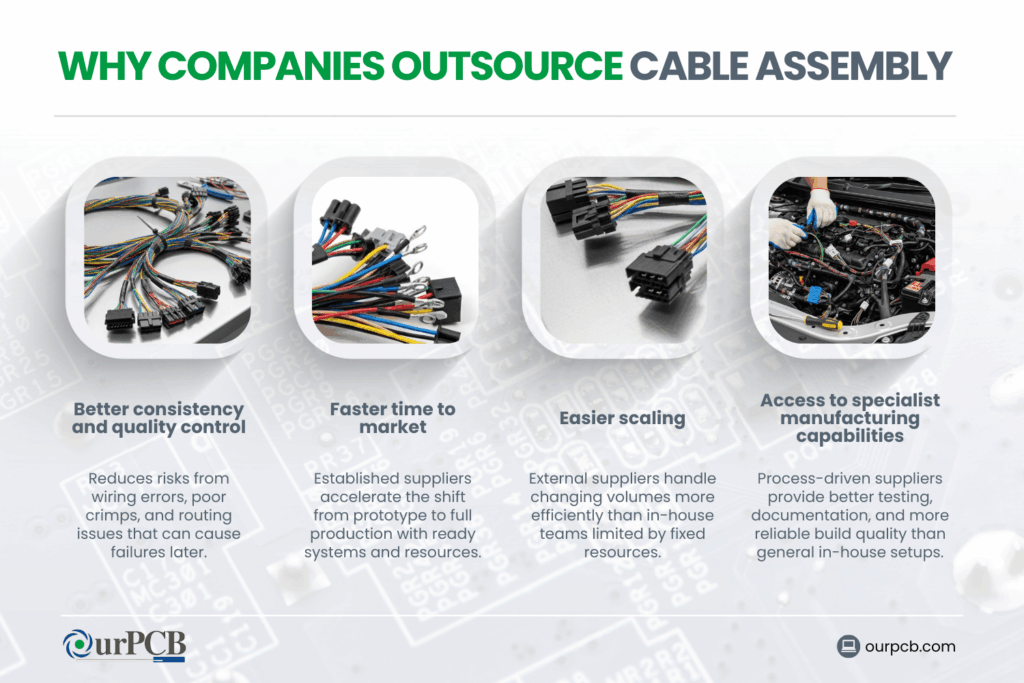
Companies usually outsource cable assembly when in-house production creates more cost, complexity, and delay than it's worth. What looks manageable at first becomes harder to control as volumes grow, quality requirements increase, or timelines tighten.
What's easy to underestimate is how far those costs actually extend. In-house assembly costs go beyond parts and direct labor — it requires crimping tools, wire processing equipment, inspection processes, test capabilities, trained operators, documented work instructions, revision control, and floor space. And because wire harness and cable assembly work is still highly manual – Siemens notes that 80–85% of a wire harness is still handmade – those costs compound quickly when rework and troubleshooting start consuming internal time.
Beyond cost, a few other pressures typically drive the decision:
- Better consistency and quality control: Small inconsistencies like poor crimps, mis-routing, or wiring variations may not surface immediately, but they can cause failures during testing, installation, or field use.
- Faster time to market: A supplier with equipment, staff, and production systems already in place can reduce the time needed to move from prototype to full production.
- Easier scaling: An outsourced supplier can handle changing order volumes more efficiently than an internal team constrained by fixed labor, equipment, and floor space.
- Access to specialist manufacturing capabilities: Suppliers organized around repetitive, process-controlled manufacturing can offer better testing, clearer documentation, and more reliable build execution than an in-house setup built for broader tasks.
Special Offer: Get $100 off your order!
Email [email protected] to get started!
What Should a Good Outsourcing Partner Provide?
A good cable assembly partner should offer more than assembly labor. At a minimum, they should be able to provide drawings and bills of materials (BOMs), source approved materials, manage revisions, carry out required testing, and maintain clear traceability records.
They should also be able to explain how they control substitutions, document changes, and verify finished assemblies. Just as important, testing and traceability should be built into the process, not handled as informal final checks.
Which Standards & Certifications Should You Look for in a Supplier?
| Standard / Program | Why it matters | Applicable industries |
|---|---|---|
| IPC/WHMA-A-620 | Main quality standard for cable and wire harness assemblies. Defines acceptance criteria for materials, assembly methods, testing, and finished quality. | Cable assemblies, wire harnesses, electronics, industrial equipment, automotive, telecom, medical devices |
| ISO 9001 | Confirms that the supplier has a documented quality management system and controlled processes. | General manufacturing, electronics, industrial equipment, automotive, medical manufacturing |
| UL Wiring Harness Traceability Program | Helps verify material traceability and compliance where UL-related documentation is required. | Appliances, electrical products, OEM equipment, regulated electrical assemblies |
Common Risks When Outsourcing Cable Assembly
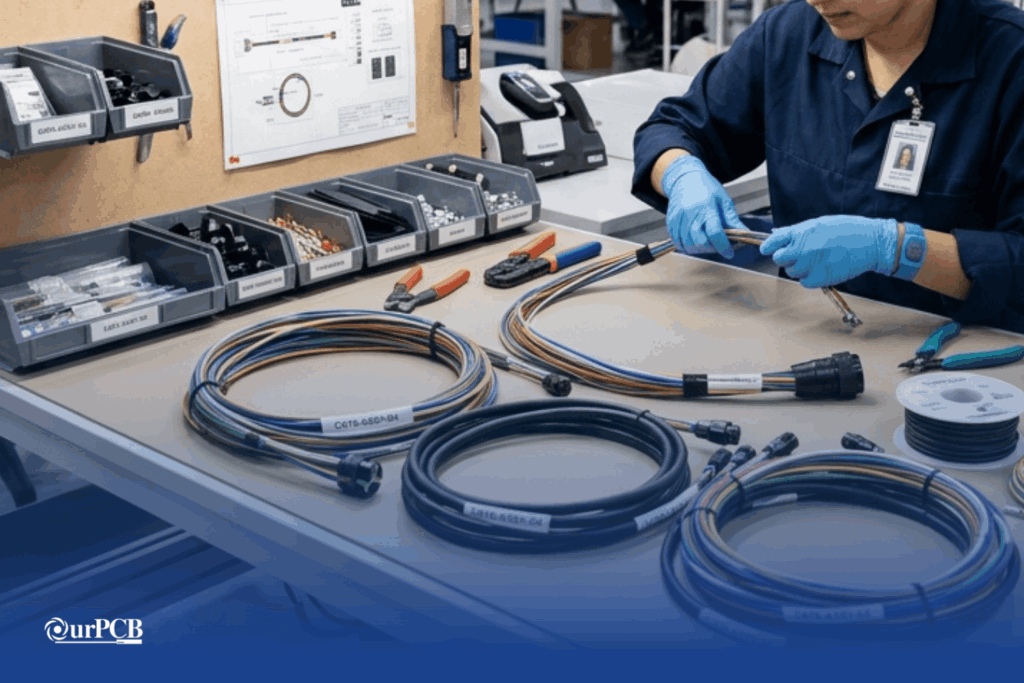
Outsourcing cable assembly can improve cost, speed, and scalability, but only proper control over the supplier and process enables these improvements. Most problems come from gaps in quality, communication, or documentation, rather than the outsourcing model itself.
- Choosing on price alone:
The lowest quote often translates to weak testing, poor documentation, uncontrolled part substitutions, and a lack of process control. - Unclear build requirements:
If drawings or expectations aren’t clear, the supplier may build something that looks correct but still causes problems in production or installation. - Weak traceability:
Without clear material and lot tracking, it becomes harder to identify issues, contain defects, and understand what was affected.
The main takeaway is that outsourcing risk usually derives from poor supplier selection and weak process control. A strong manufacturing partner should be able to explain how they manage quality, communication, and traceability before production begins.
Work with OurPCB on Outsourced Cable Assembly
If you're planning to outsource cable assembly, we build custom cable assemblies and wire harnesses to exact specifications across automotive, EV, robotics, and other demanding electronic systems.
Whether you're moving from prototype into production or replacing an inconsistent in-house process, we can turn your drawings, BOMs, test expectations, and sourcing requirements into a repeatable build process from day one. Contact us to discuss your cable assembly requirements and get a quote.
Outsource Cable Assembly FAQs
How do I know whether a cable assembly supplier can really handle my project?
Start by checking whether the supplier can support your connector families, wire types, testing requirements, documentation needs, and production volumes. Then look at how they explain traceability, revision control, and quality standards. A supplier who only discusses price and lead time typically offers insufficient visibility into how the job will actually be controlled.
Should I supply the components myself or let the manufacturer source them?
Both approaches can work, but they shift control in different ways. Customer-supplied components can help maintain tighter control over approved parts, while supplier sourcing can reduce procurement friction and improve responsiveness. The important thing is to define substitution rules, responsibility for shortages, and the documentation needed to prove that the correct components were used.
Can outsourcing still make sense for low-volume or prototype work?
Yes, especially when internal teams don’t want to invest in specialized labor and tooling for work that is intermittent or likely to scale later on. Prototype outsourcing can also make the transition to production smoother when the same supplier helps define the baseline, testing expectations, and build approach early on.
Is outsourcing cable assembly only about reducing costs?
No, cost influences the decision, but improved repeatability, access to specialist processes, faster scaling, and reduced operational drag on internal teams usually present a stronger case. That is why industry experts consistently present outsourcing as a strategic manufacturing choice rather than just a purchasing shortcut.
Back to Top: Outsource Cable Assembly | When It Makes Sense and How to Do It Right
Special Offer: Get $100 off your order!
Email [email protected] to get started!