A shielded cable assembly is designed to protect signals from electromagnetic interference (EMI) and radio frequency interference (RFI) by surrounding the conductors with a conductive shield. Depending on the design, that shield may reflect noise, help carry it away through a grounding path, or do both. The result is a more reliable assembly for environments where clean transmission matters.
If you’re building a product that combines boards, wiring, and enclosure-level integration, shielding should be considered early in the project, rather than treated as a last-minute fix. At OurPCB, we support projects that need coordinated PCB assembly, wire harness manufacturing, and production support, so signal integrity decisions can be considered alongside manufacturability, sourcing, and final assembly.
Key Takeaways
- Shielded cable assemblies are used to reduce EMI and RFI that can disrupt signal transmission.
- Foil shielding offers full coverage, while braided shielding is easier to terminate and offers between 70% to 95% coverage.
- The shield alone is not enough. Connector design, shield continuity, and proper grounding or bonding all affect real-world performance.
- The right design depends on the environment, signal sensitivity, flex requirements, connector strategy, and overall system design.
What is a Shielded Cable Assembly?
A shielded cable assembly is a cable assembly that includes a conductive shielding layer around the signal or power conductors to help reduce outside interference. That shielding is usually made from foil, braided metal, or a combination of both, depending on the electrical and mechanical demands of the application.
Shielded assemblies are commonly used when signal quality matters and the cable will be installed near power equipment, motors, control systems, switching electronics, or other noise sources.
The important detail is that shielding isn’t just a material choice. Real performance depends on the complete assembly. The cable, connector, termination method, and grounding strategy all need to work together. If the shield is broken at the connector or not terminated correctly, the assembly may not perform the way the design intended.
Why does Shielding Matter?
Electronic and electrical systems both generate and are exposed to electromagnetic energy, which is why shielding matters most when cables run through noisy environments or when signal integrity is critical.
In industrial settings, Fluke reports that over 50% of Industrial Ethernet failures are related to cabling, and in one example, a single defective cable near a variable frequency drive (VFD) corrupted 10% of Ethernet frames while the motor was running.
Those figures show why standard insulation and jackets aren’t enough on their own: they protect mechanically, but shielding is the dedicated layer that helps preserve signal integrity when EMI becomes a real performance risk.
How a Shielded Cable Assembly Works
The shield forms a conductive barrier around the conductors. That barrier can help reflect incoming electromagnetic energy and carry collected noise away through a grounding path. This reduces the amount of interference that reaches the signal conductors and thus helps maintain cleaner transmission.
For that reason, a shielded cable assembly should be treated as a system. The shield has to remain continuous through the connector area, and the termination has to support proper grounding or bonding for the design. In high-performance builds, 360-degree shielding continuity through the connector path is a major part of maintaining signal integrity.
Special Offer: Get $100 off your order!
Email [email protected] to get started!
What are Common Types of Shielding?
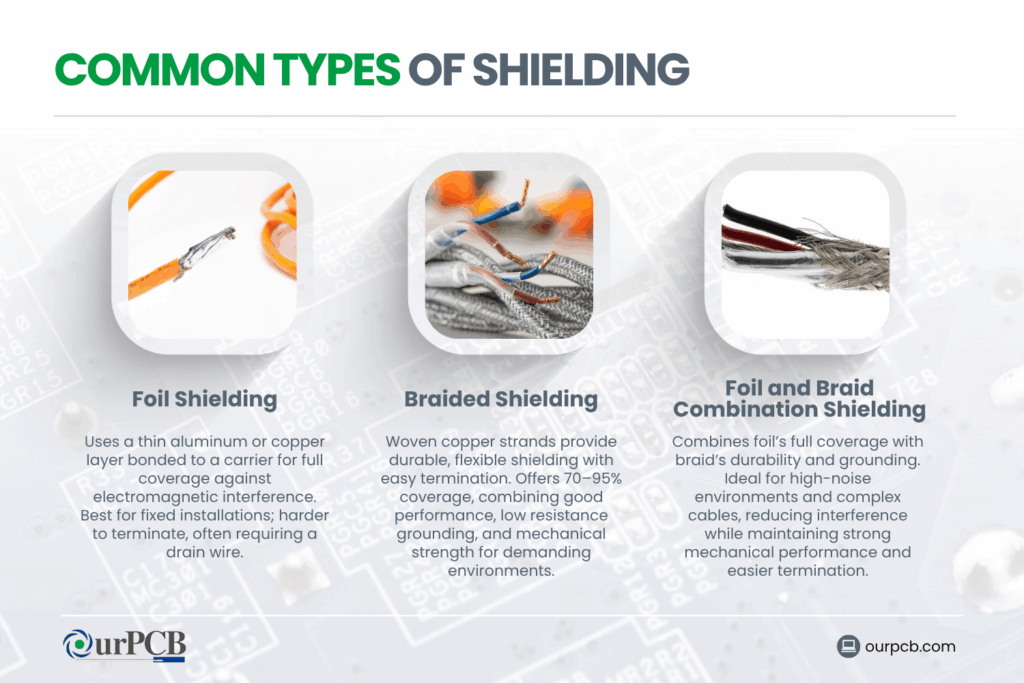
Different shield types are used to solve different electrical and mechanical challenges. The right option depends on the level of EMI protection needed, how the cable will be installed, how much flex or movement it will experience, and how easy the shield needs to be to terminate. In most cable assemblies, shielding falls into three main categories: foil, braided, or a combination of both.
Foil shielding
Foil shielding uses a thin metal layer, often aluminum or copper, bonded to a carrier material such as polyester. Its main advantage is coverage. Foil shields provide full coverage around the conductors, which makes them useful when broad protection from external electromagnetic energy is needed.
The tradeoff is termination. Because foil is thin and delicate, it’s generally harder to terminate directly at the connector. In many builds, a drain wire is used to terminate and ground the foil shield instead. Foil shielding is a strong option for fixed installations where high coverage matters more than repeated flexing.
Braided shielding
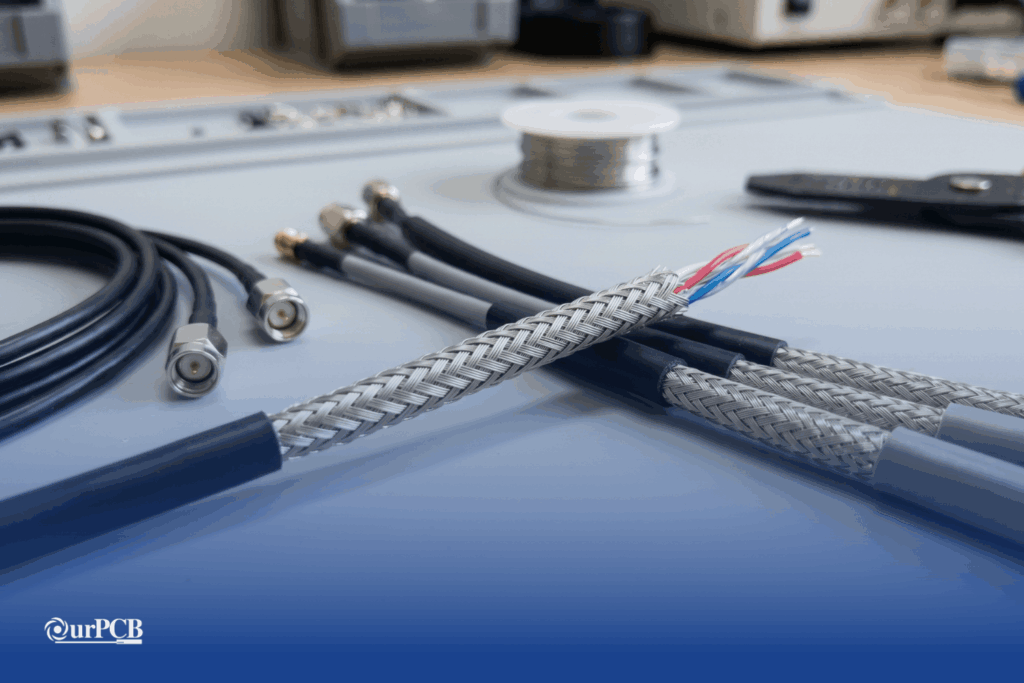
Braided shielding uses woven strands of bare or tinned copper around the conductors. This creates a low-resistance path to ground and makes braid easier to terminate with crimping or soldering. Braided shielding is also mechanically tougher than foil in many applications.
Unlike foil, braid does not provide full coverage. Typical braid coverage is often in the 70% to 95% range, depending on the weave. Even so, it’s widely used because it combines good shielding performance with easier termination and better durability in more demanding physical environments.
Foil and braid combination shielding
In harsher or noisier environments, cable designs often use both foil and braid. This combination gives the assembly the full-coverage benefit of foil and the grounding and termination advantages of braid. It’s a practical choice when both electrical noise and real-world durability matter.
Combination shielding is also useful in composite and multi-conductor cable designs where pair-to-pair interference needs to be reduced. In some constructions, individual pairs are shielded while the overall cable also includes an outer shield.
Shielded vs. Unshielded Cable Assembly
| Factor | Shielded Cable Assembly | Unshielded Cable Assembly |
|---|---|---|
| EMI protection | Better for reducing interference in noisy environments | Limited protection against external EMI |
| Signal integrity | Better for sensitive or high-performance signals | Can perform well in balanced, controlled environments |
| Best use case | High-noise areas or applications with tighter signal demands | Low-noise environments with fewer interference risks |
| Size and flexibility | Usually larger and less flexible | Usually smaller and more flexible |
| Installation | May require more care with grounding and termination | Generally easier to install |
| Cost | Typically more expensive | Typically more cost-effective |
| Main advantage | More stable performance where interference is a risk | Simpler, lighter, and often sufficient in controlled settings |
Shielded cable assembly is not automatically better in every case. In balanced, controlled environments, unshielded cable can still perform well and may be smaller, more flexible, easier to install, and less expensive. The right choice depends on the environment and the performance requirement, not just on the assumption that more shielding is always safer.
Where shielded designs have the advantage is in environments with significant electromagnetic noise, tighter signal integrity demands, or a higher risk of interference between nearby systems. In those conditions, shielding can be the difference between stable performance and recurring signal issues.
How to Choose the Right Shielded Cable Assembly
1. Start with the noise environment
Look at where the cable will operate. A quiet internal device build will have different requirements than a factory-floor installation, a telecom rack, or a system mounted near motors, drives, and switching equipment. Understanding the environment should come before selecting the shield type.
2. Match the shield type to the application
Foil is useful when full coverage is a priority. Braid is useful when easier termination, grounding performance, and better mechanical ruggedness are needed. A foil-plus-braid construction is often the strongest choice when the application combines high noise with real-world handling demands.
3. Think about flex and movement
Not every shield handles movement the same way. Foil-only designs are less ideal in continuous flex applications because repeated movement can damage the foil over time. If the cable will move regularly, the mechanical side of the design matters just as much as the EMI side.
4. Do not ignore the connector and termination
A shielded cable can underperform if the connector strategy is poor. The shield should remain continuous through termination, and the connector system should support the intended shielding approach. This is especially important in compact, high-speed, or high-density assemblies.
5. Plan grounding and bonding properly
A shield needs an effective termination path to do its job. Poor grounding or incomplete bonding can reduce shielding effectiveness and create performance issues. Grounding details vary by application, but the main takeaway is simple: design the cable, connector, and system grounding approach as an integrated system.
6. Balance performance with manufacturability
Cable size, flexibility, routing space, cost, and assembly complexity all affect the final decision. The best design isn’t just the one with the most shielding. It’s the one that gives the product the performance it needs without creating unnecessary cost or manufacturing difficulty.
Common Applications for Shielded Cable Assemblies
Shielded cable assemblies are used across a wide range of products and industries because many electronic systems operate in environments where EMI can affect reliability. Common applications include:
- industrial control systems
- factory automation
- telecommunications equipment
- medical devices
- automotive electronics
- data-heavy electronic systems
- OEM equipment and control assemblies
These applications all have slightly different priorities, but they all share one common need: consistent electrical performance in real operating conditions.
Get Your Shielded Assembly Built Right
Choosing the right shielded cable assembly comes down to understanding your environment, matching the shield type to your application's electrical and mechanical demands, and making sure grounding, termination, and connector strategy are all considered together. Getting those decisions right early – before production starts – is far easier than correcting them later.
OurPCB is a one-stop PCB assembly manufacturer offering wire harness manufacturing, component sourcing, casing and housing manufacturing, and testing services. Operating since 2005, we have served over 2,500 customers across the industrial, medical, telecom, and automotive sectors, from our ISO 9001-certified, 5,000 m² factory in China. With authorized component procurement from suppliers like Arrow and Avnet, and IPC Class 3 assembly with full traceability, every project is built to consistent, verifiable standards.
If your project includes a shielded cable or harness requirement alongside PCB assembly, contact us for a quote and get your design, sourcing, and manufacturing all aligned from the start.
Shielded Cable Assembly FAQs
What information do I need to provide to get a quote for a shielded cable assembly?
At minimum: cable length, conductor count, wire gauge, connector types, shield type preference, and the operating environment. If you have a drawing or an existing sample, that speeds things up considerably. The more detail you provide upfront, the more accurate the quote.
Can OurPCB match a shielded cable assembly to an existing PCB design?
Yes. Because we handle both PCB assembly and cable or harness manufacturing, connector pinouts, signal routing, and shielding requirements can be reviewed together. This reduces the risk of mismatches between the board and the cable during integration.
Is prototype quantity available for shielded cable assemblies?
Yes, at OurPCB, we support low-volume prototype runs and production-scale orders. Starting with a prototype is a practical way to validate the design, test the connector fit, and confirm shielding performance before committing to full production volumes.
How does shielding affect connector selection?
Not every connector supports proper shield termination. For shielded assemblies, the connector housing needs to provide a continuous ground path for the shield. Backshells, conductive housings, and specific termination methods are often required. Choosing a connector that doesn't support the shielding approach can undermine the whole design.
Do shielded cable assemblies cost significantly more than unshielded ones?
The cost difference depends on the shield type, cable construction, and connector requirements. Foil-only shielding adds relatively little cost. Braid or combination shielding, along with more complex termination or backshells, adds more. That said, the cost of addressing EMI failures in the field typically far outweighs the upfront investment in proper shielding.
What testing is typically done on shielded cable assemblies before shipment?
Standard tests include continuity, insulation resistance, and hi-pot (high-potential) testing to verify the shield and conductors are performing correctly. Depending on the application, pull-force testing on terminations and visual inspection against workmanship standards like IPC/WHMA-A-620 may also apply. Ask your manufacturer which tests are included and whether test reports are provided with the order.
Back to Top: Shielded Cable Assembly | What it is and How it Works
Special Offer: Get $100 off your order!
Email [email protected] to get started!