From the moment you turn the key or press “Start,” your car’s electrical system comes alive. Power flows from the battery to the starter, lights illuminate the road ahead, sensors monitor engine performance, and modules communicate with each other seamlessly. Behind all of this is a hidden but vital component - the wiring harness.
In this comprehensive guide, OurPCB will explain what a wiring harness in a car is, how it routes electrical power and signals, and the types of wiring harnesses found in today’s automobiles. You’ll gain a clear understanding of what harness wires in a car do and why these assemblies are essential.
What is a Wiring Harness in a Car?
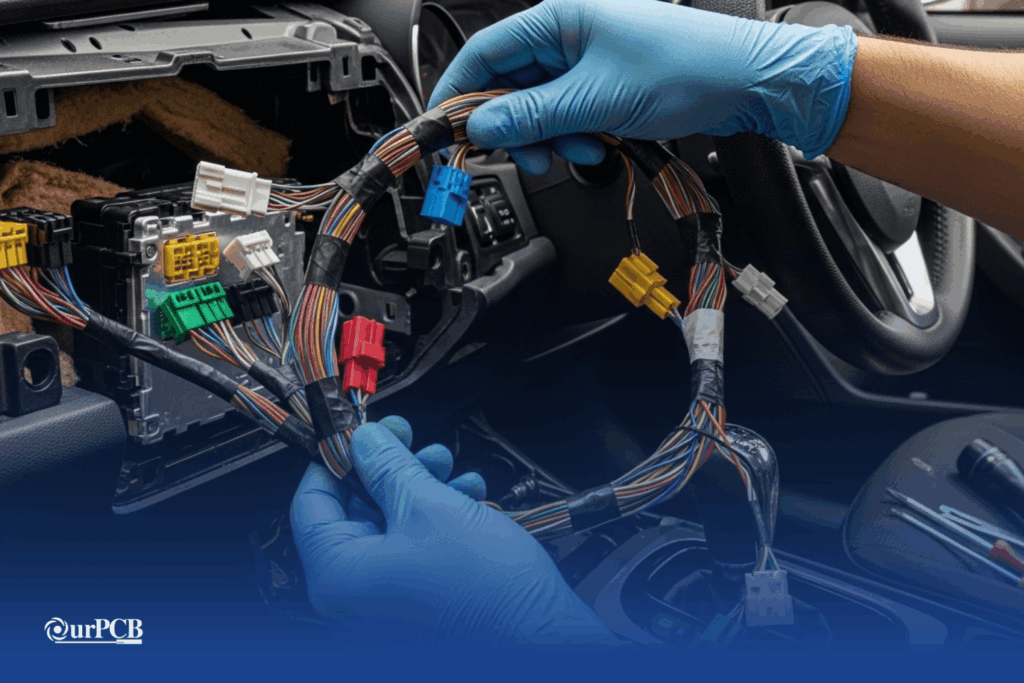
A wiring harness in a car, also called a wire harness, cable harness, or wiring loom, is a bundled assembly of wires, terminals, connectors, and protective coverings that route electrical power and signals throughout the vehicle.
In simpler terms it’s the organized network that links nearly every electrical component, allowing them to communicate and operate reliably.
The wiring harness acts like the nervous system of your car, transmitting electricity and signals between all electronic modules. Without it, the car’s electrical and electronic systems would be disconnected, inefficient, and prone to failure.
Why do Cars Use Wiring Harnesses?
Cars contain hundreds or even thousands of individual wires, and routing each one separately would make installation extremely complex. The likelihood of loose or crossed connections would increase significantly, repairs would become far more difficult, and electrical noise or system failures would be more common.
A wiring harness solves these problems by bundling conductors into organized pathways, simplifying assembly, protecting wires from damage, and reducing the risk of shorts and reliability issues.
What are the 10 Core Types of Wiring Harness in Cars
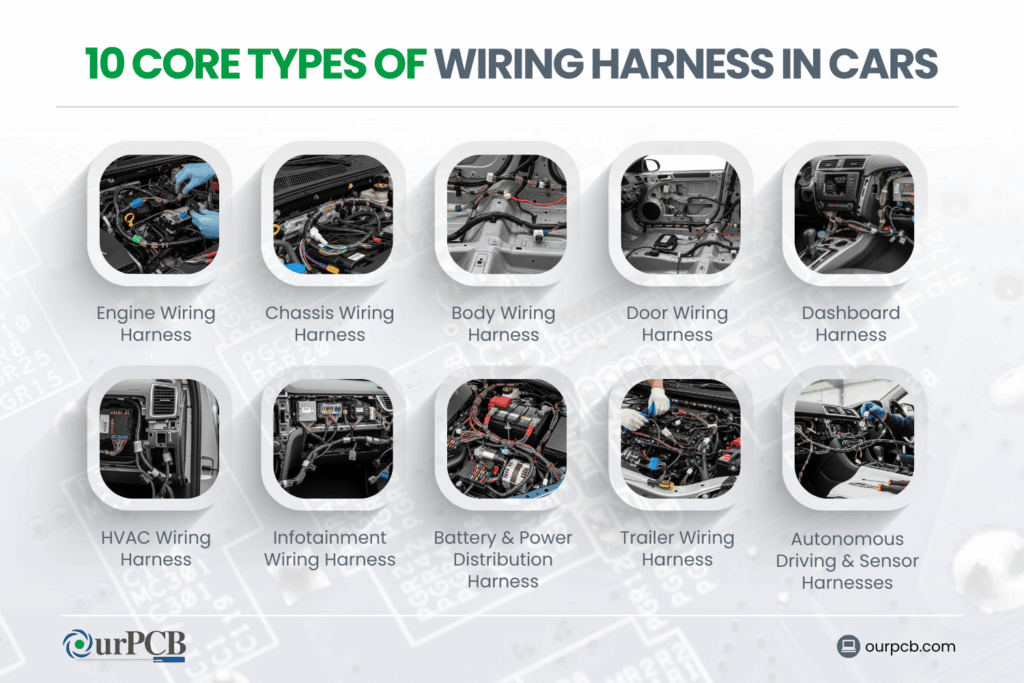
Automobiles use many specialized wiring harnesses, each designed for a particular part of the vehicle’s electrical and electronic architecture. Below are the most common types of wiring harnesses you’ll find in cars.
| Wiring Harness Type | Primary Function | Key Connected Components | Design Considerations |
|---|---|---|---|
| Engine Wiring Harness | Connects ECU to engine systems | Fuel injectors, spark plugs, oxygen sensors, ignition coils, coolant temp sensors | High heat resistance, vibration durability, robust insulation and connectors |
| Chassis Wiring Harness | Supports safety and exterior vehicle functions | Headlights, taillights, turn signals, brake lights, ABS sensors, suspension controls, horns | Routed through frame; must handle environmental exposure and structural integration |
| Body Wiring Harness | Powers interior body systems | Interior lighting, power windows, locks, infotainment, dashboard switches | Supports comfort features; complex interior routing |
| Door Wiring Harness | Supplies power to door-mounted systems | Power window motors, door locks, actuators, mirrors, speakers | Flexible design to withstand repeated opening/closing cycles |
| Dashboard (Instrument Panel) Harness | Centralizes driver information systems | Speedometer, tachometer, warning lights, HVAC panels, radio, navigation displays | Dense routing; critical for driver communication and control |
| HVAC Wiring Harness | Controls climate systems | Blower motors, temperature sensors, A/C compressor controls, HVAC panel | Must ensure accurate signal transmission for climate responsiveness |
| Infotainment Wiring Harness | Supports entertainment and connectivity | Audio systems, GPS, touchscreens, Bluetooth, internet modules | Carries power and data; requires shielding in advanced systems |
| Battery & Power Distribution Harness | Handles high-current power circuits | Battery, starter motor, alternator, major electrical loads | Large-gauge wires, reinforced insulation for high current |
| Trailer Wiring Harness | Connects vehicle to trailer electrical systems | Trailer tail lights, brake lights, turn signals | Must meet standards (e.g., ISO 1724); ensures safe signal transfer |
| Autonomous Driving & Sensor Harnesses | Powers and connects ADAS systems | Radar, LiDAR, cameras, processors, V2V modules | High data capacity, EMI shielding, environmental durability |
1. Engine Wiring Harness
Perhaps the most critical harness in the vehicle, the engine wiring harness connects the engine control unit (ECU) with all engine-related sensors and actuators. This includes components such as:
- Fuel injectors
- Spark plugs
- Oxygen sensors
- Ignition coils
- Coolant temperature sensors
Because the engine bay experiences extreme heat and vibrations, this harness is engineered with durable insulation and robust connectors to maintain performance under harsh conditions.
2. Chassis Wiring Harness
The chassis wiring harness runs through the vehicle’s frame and connects features including:
- Headlights and taillights
- Turn signals and brake lights
- ABS sensors and suspension controls
- Horns and safety systems
This harness supports essential safety and visibility functions while navigating the complexities of a car’s structural components.
3. Body Wiring Harness
The body wiring harness serves electrical systems in the vehicle’s body and interior. It delivers power and signal connections to:
- Interior lighting
- Power windows and locks
- Audio and infotainment systems
- Dashboard controls and switches
It plays a major role in delivering comfort and convenience features throughout the cabin.
4. Door Wiring Harness
Doors contain multiple electrical components that must work reliably through repeated opening and closing. The door wiring harness supplies power to:
- Power window motors
- Door locks and actuators
- Side mirror controls
- Speaker systems
This harness must be flexible and reinforced to avoid wear due to movement.
5. Dashboard (Instrument Panel) Harness
The dashboard harness connects the vehicle’s main control center:
- Speedometer and tachometer
- Warning lights and indicators
- HVAC (climate control) panels
- Radio, navigation, and infotainment displays
It essentially centralizes all interior electrical connections related to driver information and comfort.
6. HVAC Wiring Harness
The HVAC harness connects and controls the heating, ventilation, and air conditioning systems. It links:
- Blower motors
- Temperature sensors
- A/C compressor controls
- HVAC control panel
This harness ensures climate systems respond accurately to driver settings.
7. Infotainment Wiring Harness
Modern vehicles have rich entertainment and connectivity systems. The infotainment harness manages connections for:
- Audio systems and speakers
- GPS navigation units
- Touchscreens and displays
- Bluetooth and internet modules
Advanced systems may also integrate Wi-Fi, vehicle diagnostics, and smartphone interfaces.
8. Battery and Power Distribution Harness
This wiring harness handles high-current circuits that:
- Connect the battery to the starter motor and alternator
- Distribute power to major electrical loads and systems
- Support charging systems, especially in hybrid and electric vehicles
Battery harnesses use larger-gauge wires and reinforced insulation due to higher electrical loads.
9. Trailer Wiring Harness
If your car is towing, the trailer wiring harness connects vehicle signals to:
- Tail lights
- Brake lights
- Turn signals on the trailer
Standards such as ISO 1724 (7-pin) define these harness connections for safe and reliable trailer operation.
10. Autonomous Driving and Sensor Harnesses
Modern advanced driver-assistance systems (ADAS) require extensive wiring harnesses for:
- Radar, LiDAR, and camera sensors
- Processor and control modules
- Vehicle-to-vehicle communications
These harnesses carry both power and large amounts of data while maintaining resistance to electrical noise and environmental factors.
Special Offer: Get $100 off your order!
Email [email protected] to get started!
Emerging Wiring Harness Categories
With the rise of electric and hybrid vehicles, wiring harness design has expanded to include:
- High-Voltage Harnesses (for EV drivetrain and battery systems)
- Optical Harnesses (for high-speed data transmission)
- Shielded Sensor Networks (for autonomous and connected systems)
These advanced harnesses reflect the evolving complexity of vehicle electronics and electrification.
How Wiring Harness Types are Selected
Wiring harnesses in cars are not one-size-fits-all. Automotive engineers consider factors such as:
- Electrical load and wire gauge
- Environmental exposure (heat, vibration, moisture)
- Connector and terminal reliability
- Compliance with automotive standards
- Ease of assembly and maintenance
Every harness type is engineered to balance performance, safety, durability, and cost, often requiring custom design and testing.
Conclusion | Why Understanding Wiring Harness Types Matters
Understanding the types of wiring harness in a car is essential whether you’re an automotive engineer, technician, hobbyist, or vehicle owner curious about how modern cars function. Each harness type serves a specific function, from power distribution and safety systems to comfort and connectivity features.
In summary:
- A car harness organizes hundreds of wires into purposeful assemblies
- Different harness types support specific functional zones of the vehicle
- Modern cars use both traditional and advanced harness technologies to manage electrical complexity
By grasping what harness wires in a car do and how different wiring harness types function, you gain a deeper appreciation for the invisible systems powering today’s vehicles. Contact OurPCB for automotive wire harnesses and cable assemblies.
FAQs on Types of Wiring Harness in Cars
How long should a car wiring harness last?
A wiring harness in a vehicle can last many years but its lifespan depends on factors like material quality, environmental exposure (heat, moisture, vibration), and maintenance practices. Regular inspections and quality manufacturing help extend its durability.
What are common wiring harness problems and how do they show up?
Wiring harness issues can show as flickering lights, intermittent power loss, blown fuses, or electronic systems failing to respond. Physical signs may include frayed wires, damaged insulation, or corroded connectors.
Are automotive wiring harnesses universal between different cars?
No. Wiring harnesses are engineered for specific vehicle makes and models. Lengths, connectors, gauge sizes, and routing are tailored to individual designs, meaning harnesses are generally not interchangeable between different vehicles.
Back to Top: What are the Different Types of Wiring Harness in Car?
Special Offer: Get $100 off your order!
Email [email protected] to get started!