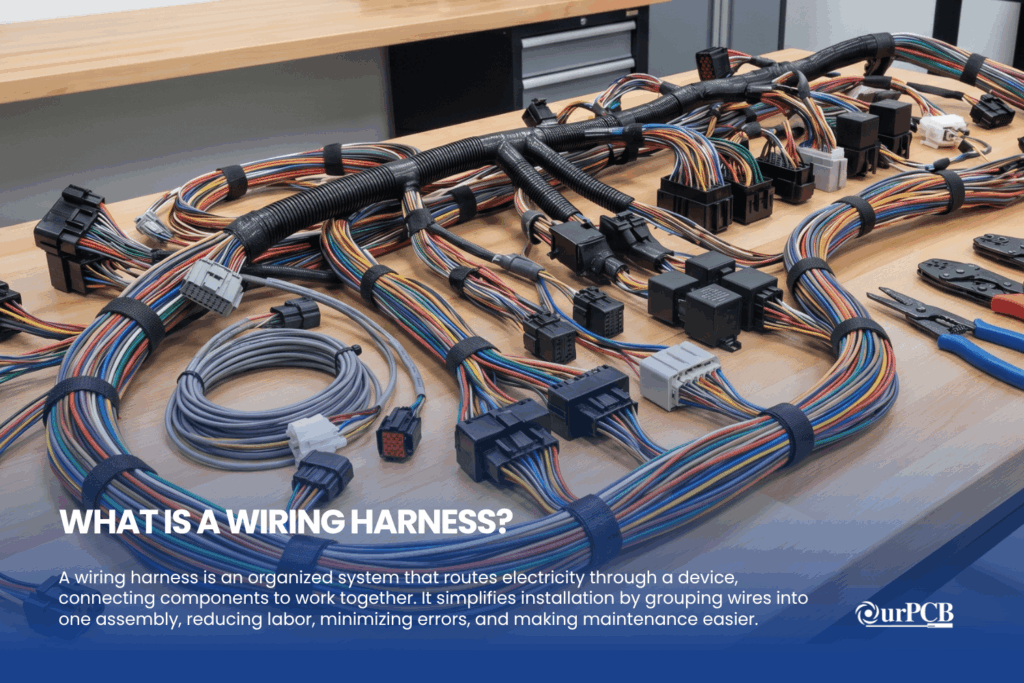
A wiring harness is an organized group of wires, terminals, connectors, and protective materials that carries electrical power and signals between different parts of a system.
Instead of leaving individual wires loose, a wiring harness brings them together into one structured assembly. That makes the system easier to install, easier to service, and better protected against wear. In products with many electrical connections, that organization is not just helpful; it’s essential.
Key Takeaways
- A wiring harness groups wires, connectors, and protective materials into one organized assembly.
- It helps carry power and signals while improving protection, installation speed, and reliability.
- Common harness components include wires, terminals, connectors, sleeving, ties, and routing hardware.
- Wiring harnesses are used across automotive, industrial, robotics, medical, appliance, and electronics applications.
- Custom harness design matters because wire size, connector type, routing, and protection must match the environment.
What is a Wiring Harness in Simple Terms?
In simple terms, a wiring harness is like the nervous system of a machine. It's a neatly organized network of 'nerves' (wires) that tells the 'muscles' (motors) what to do and sends feedback from the 'senses' (sensors) back to the 'brain' (control unit).
How does a Wiring Harness Work?
A wiring harness works by routing electrical power and signals between components in a controlled way.
For example, in an industrial machine, one harness might connect sensors, switches, motors, and control boards. In an automotive application, the harness may connect lighting, battery systems, control modules, displays, and other electrical functions. In both cases, the harness keeps conductors organized while protecting them from movement, friction, heat, and environmental stress.
The harness does more than just connect point A to point B. It helps define how the system is assembled, how space is used, and how reliable the final product will be over time.
What are the Main Parts of a Wiring Harness?
A wiring harness comprises several parts that work together as one system:
Wires and cables
These carry the electrical current or signal. The selected wire type depends on the application, required flexibility, current load, voltage, and environment.
Terminals
Terminals are attached to the ends of wires to create an electrical and mechanical connection. Crimping secures each terminal before insertion into a connector or attachment to a stud or device.
Connectors
Connectors join the harness to other parts of the system. They allow the harness to plug into boards, modules, sensors, motors, or other assemblies. Connector selection affects fit, durability, sealing, and serviceability.
Protective coverings
Protective coverings shield the harness from external damage. Material selection depends on the operating environment, with options chosen to resist abrasion, UV exposure, moisture, or general wear.
Cable ties, clips, and clamps
These hold the harness in the correct shape and position. They help maintain routing and reduce movement that can cause damage over time.
Grommets and routing hardware
Grommets seal and protect the harness where it passes through panels or around edges, preventing chafing and insulation damage at those contact points. Routing hardware, such as brackets, guides, and clamps, keeps the harness on its intended path through the assembly.
Each of these parts matters. A wire harness is not just a bundle of wires; it’s a designed assembly where every material and connection has a job.
Special Offer: Get $100 off your order!
Email [email protected] to get started!
Where are Wiring Harnesses Used?
Wiring harnesses are used in a wide range of industries because many electrical systems rely on multiple interconnected components.
Automotive
Harnesses connect lighting, sensors, battery systems, dashboards, control units, infotainment, and more. Automotive harnesses often need to handle vibration, temperature changes, and tight packaging requirements.
Industrial equipment
Machines, control panels, automation systems, and production equipment rely on harnesses to connect power and signals across moving or fixed systems.
Robotics
Robotic systems often require compact routing, repeated flexing, and dependable signal transmission. Harness design becomes especially important where movement and space constraints overlap.
Medical equipment
Medical devices depend on stable, precise electrical connections. In these systems, cleanliness, consistency, and reliability are especially important.
Consumer electronics and appliances
Harnesses are used in products such as displays, HVAC units, home appliances, and embedded electronic systems where multiple components need organized internal connections.
Aerospace and transportation
These applications often demand strict performance requirements, careful routing, and reliable protection against vibration and environmental stress.
Wiring Harness vs. Cable Assembly | What is the Difference?
These terms are often used closely, but they are not always the same in practice. In simple terms, a wiring harness is often better suited to complex internal routing with multiple connection points, while a cable assembly is often used where a finished cable needs to connect one device or module to another.
| Feature | Wiring Harness | Cable Assembly |
|---|---|---|
| Basic definition | Multiple individual wires grouped together into one organized assembly | One or more cables built as a more self-contained assembly |
| Structure | Uses separate wires arranged with protection and routing hardware | Uses cable(s) that already have their own outer jacket |
| Common materials around conductors | Protective materials, ties, sleeves, tape, clips, or routing hardware | Outer cable jacket, often with end connectors |
| Layout style | Often includes branches and breakouts | Usually follows a more direct point-to-point structure |
| Best use case | Complex internal routing with multiple connection points | Connecting one device or module to another |
How is a Wiring Harness Designed?
Wire harness design starts with the application.
The designer needs to know what the harness must do, where it will be used, how much power it will carry, what signals it needs to support, and what conditions it will face. Those details shape material and component selection.
A typical design process includes:
- defining the electrical requirements
- selecting wire gauges and insulation materials
- choosing connectors and terminals
- planning routing paths and branch points
- adding protection against heat, abrasion, vibration, or moisture
- preparing drawings, bills of materials, and assembly documentation
- validating the design before production
A harness for a medical system is not designed the same way as one for industrial machinery or a vehicle. The operating environment changes the design priorities.
What Materials are Used in a Wiring Harness?
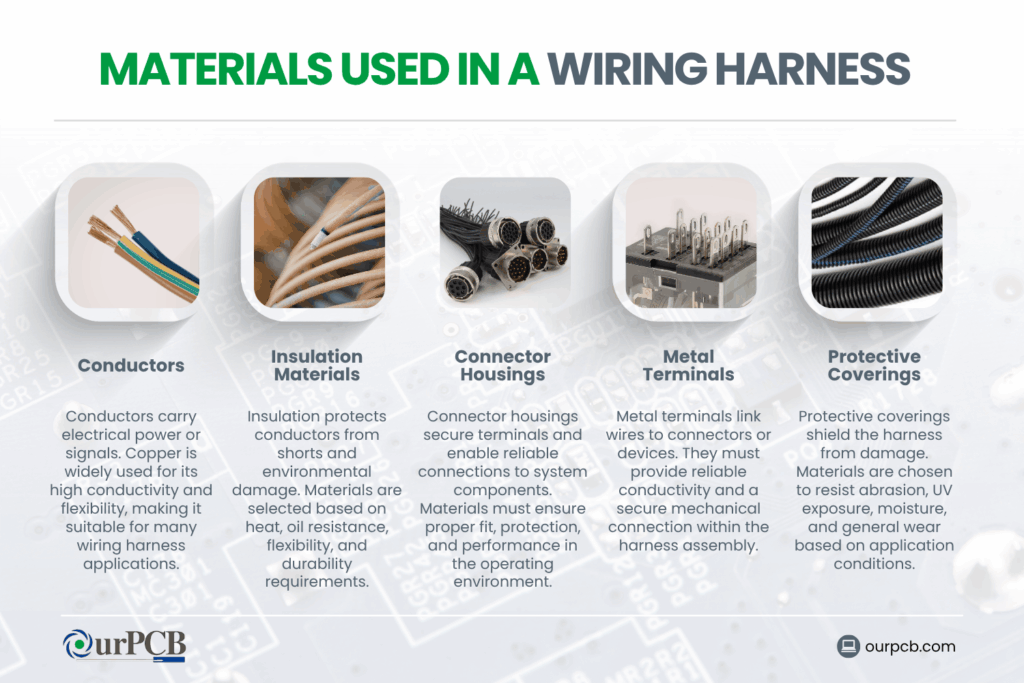
The materials used in a wiring harness vary by component and application, but most harnesses are built from a few core material categories. Each one plays a different role in electrical performance, durability, and environmental protection.
Copper
Copper is the most widely used conductor material in wiring harnesses. It offers high electrical conductivity, good flexibility, and strong resistance to fatigue from repeated bending. It is well suited for automotive, industrial, and robotic applications.
Most harnesses use stranded copper wire rather than solid wire. Stranded construction handles vibration and movement better, which matters in applications where the harness flexes during operation. Tinned copper adds a protective coating that improves corrosion resistance in humid or chemically exposed environments.
Aluminum
Aluminum is a lighter and lower-cost alternative to copper. It's used in applications where weight reduction is a priority, such as in automotive harnesses for electric vehicles. Because aluminum is less conductive than copper, wires need a larger cross-section to carry the same current load.
Polyvinyl Chloride (PVC)
PVC is one of the most common insulation materials for general-purpose wiring harnesses. It's cost-effective, flexible, and provides solid protection against moisture and abrasion. You'll find PVC-insulated wire in appliances, industrial equipment, and many standard electronic assemblies.
Its main limitation is temperature range. In high-heat environments, other insulation materials are a better fit.
Cross-linked polyethylene (XLPE)
XLPE handles higher temperatures than standard PVC and offers better resistance to chemicals and mechanical stress. It's a common choice for automotive and industrial harnesses where operating conditions push beyond the limits of general-purpose insulation.
PTFE
PTFE (Polytetrafluoroethylene) is used where performance demands are high. It withstands extreme temperatures, resists chemicals and moisture, and maintains stable electrical properties across a wide range of conditions. Aerospace, medical, and high-reliability industrial applications often specify PTFE-insulated wire.
Nylon and PBT
Nylon and polybutylene terephthalate (PBT) are the most common materials for connector housings. Both offer good mechanical strength, resistance to heat and chemicals, and reliable performance across a wide range of environments. PBT is often preferred in automotive applications because of its dimensional stability at elevated temperatures.
Brass and tin-plated alloys
Terminals are typically made from brass or copper alloys, often with a tin or gold plating. Brass provides the mechanical strength needed for a secure crimp, while the plating improves conductivity and protects against corrosion at the contact point. Gold plating is used in low-current signal applications where connection reliability is critical.
PET braided sleeving and corrugated conduit
For protective coverings, PET (Polyethylene Terephthalate) braided sleeving is a common choice. It's lightweight, flexible, and provides good abrasion resistance while allowing airflow around the harness. Corrugated conduit, typically made from Nylon or Polypropylene, offers stronger mechanical protection and is widely used where the harness runs through areas exposed to impact, abrasion, or sharp edges.
Heat shrink tubing, usually made from Polyolefin, is used at termination points and branch splits to seal and protect individual connections within the assembly.
What Should Buyers Look for in a Wiring Harness Manufacturer?
Choosing the wrong harness manufacturer doesn't just slow down production – it creates problems that surface later, in the field, where they're harder and more expensive to fix.
The right supplier brings more than components. They bring documented processes, consistent assembly quality, and the engineering depth to support your design from the first prototype through to volume production.
A strong supplier should be able to support:
- custom design requirements
- prototype and production volumes
- clear documentation
- consistent crimping and assembly quality
- testing and inspection
- material compliance requirements
- reliable communication throughout the project
It’s also helpful when the supplier understands how the harness fits into wider applications. That’s especially valuable when the harness must work alongside PCB assembly, enclosures, or other electronic subassemblies.
Custom Wiring Harness Manufacturing Support
A wiring harness is more than a bundle of wires. Every material, connection, and routing decision affects how the final product assembles, performs, and holds up over time. Getting those details right from the start, with a manufacturing partner who understands both harness production and the broader electrical assembly it connects to, makes that process significantly easier.
At OurPCB, we support customers who need more than just parts. We support projects that need coordinated manufacturing.
Because we work across PCB assembly and wire harness production, we can help customers simplify sourcing and reduce compatibility issues between electrical assemblies. That’s especially useful for teams building complete electronic products or subassemblies that need both board-level and harness-level support.
We focus on practical manufacturing needs: clear specifications, consistent quality, and a smoother path from concept to delivered assembly. Whether you need a harness for industrial equipment, automotive electronics, robotics, or another application, OurPCB can help you move faster with dependable manufacturing support.
Ready to start your project? Contact OurPCB today for a fast quote and let us help you build a wiring harness solution that fits your application.
Wiring Harness FAQs
What information do I need to provide to get a custom harness quote?
At minimum: wire count, connector types, approximate lengths, operating environment, and target volumes. A schematic or existing harness sample speeds the process significantly.
What testing should a wiring harness go through before shipment?
Standard testing includes continuity, hi-pot (dielectric withstand), and visual inspection. More demanding applications may also require pull testing on crimps and connector retention checks.
What certifications or standards should a wiring harness meet?
IPC/WHMA-A-620 is the primary industry standard for harness assembly quality. Depending on the application, UL listing and RoHS compliance may also be required.
What is the typical lead time for a custom wiring harness?
Prototypes generally run for two to four weeks. Production lead times vary by complexity and volume, but four to eight weeks is a common range.
What is the difference between a prototype run and volume production for harnesses?
Prototypes are built to validate the design. Volume production uses dedicated tooling and fixtures, which improves consistency and reduces per-unit cost. Moving from one to the other usually requires completing the bill of materials and assembly documentation first.
Can a wiring harness design be updated after the initial production run?
Yes, but changes to connectors, wire gauges, or routing can affect tooling and lead times. Minor updates are usually straightforward. Significant redesigns are better treated as a new prototype cycle.
What documentation should come with a custom harness order?
A complete order should include a harness drawing, bill of materials, test report, and any applicable compliance certificates. Good documentation makes incoming inspection faster and supports traceability if issues arise later.
Back to Top: What is a Wiring Harness?
Special Offer: Get $100 off your order!
Email [email protected] to get started!