Choosing a cable assembly supplier isn’t just about price, lead time, or connector availability. It is also about compliance. Failure to meet the right certification, quality, and material requirements will lead to project delays, costly redesigns, inspection failures, and significant safety risks.
This means that when evaluating suppliers, you need to look beyond the cable itself and ask the right questions early. What kind of compliance does the assembly need: product safety approval, workmanship standards, environmental compliance, or a quality system requirement? And which of those requirements are driven by the end market, the industry, or the customer's own supply chain rules?
Key Takeaways
- Cable assembly certification requirements are not one-size-fits-all. The right requirements depend on the product, market, installation method, and industry.
- UL, CE, and similar approvals are not the same as ISO 9001 or IPC/WHMA-A-620. They serve different purposes.
- IPC/WHMA-A-620 is the main workmanship and acceptance standard for cable and wire harness assemblies.
- A cable assembly built from compliant parts is not automatically compliant as a finished assembly.
- North American and European requirements often differ, especially around product safety, markings, and declarations.
- Buyers should verify product markings, test records, material compliance, and supplier quality certifications before placing an order.
What are Cable Assembly Certification Requirements?
Cable assembly certification requirements are the standards, approvals, and compliance obligations that apply to how a cable assembly is designed, manufactured, tested, documented, and sold.
These requirements fall into several categories:
- product safety approvals
- component recognition
- workmanship and acceptance criteria
- quality management certifications
- environmental compliance requirements
- industry-specific customer or regulatory requirements
Why is there No Single Certification for Every Cable Assembly?
The most important concept to understand is that cable assembly compliance is layered.
A supplier may have a certified quality management system. The assembly team may work to a recognized workmanship standard. The materials may meet environmental substance restrictions. The finished product may also need a separate safety approval or declaration for the market where it will be sold.
These are connected, but they’re not interchangeable.
For example, a supplier with ISO 9001 certification may still need to build the assembly to IPC/WHMA-A-620 workmanship criteria. That same assembly may also need UL-related compliance for a North American application or CE-related compliance for certain European markets. If the application is automotive, aerospace, or medical, additional sector-specific requirements may also apply.
Special Offer: Get $100 off your order!
Email [email protected] to get started!
What are the Main Cable Assembly Certifications and Standards for Cable Assemblies?
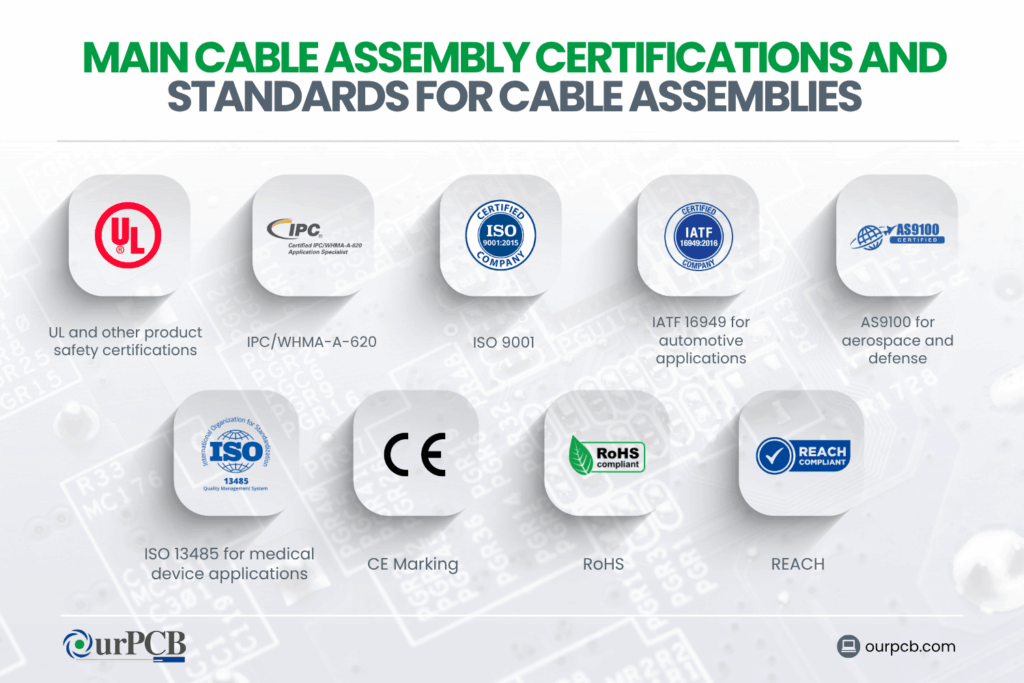
Cable assembly compliance usually involves more than one requirement. Some standards focus on product safety, while others cover workmanship, quality systems, or material compliance. The certifications and standards below each play a different role in determining whether an assembly is suitable for its intended application.
UL and other product safety certifications
For many North American applications, product safety certification is one of the first things buyers ask about.
Underwriters Laboratories (UL) is a third-party safety certification body. For North American applications, a UL mark on a cable assembly or component indicates the product has been tested and evaluated against relevant safety requirements.
UL is one of the most recognized product safety marks in the electrical industry, but it isn't the only one. Depending on the application, buyers may also encounter Canadian Standards Association (CSA) ETL marks, both of which serve a similar function for their relevant markets and installation contexts.
For buyers, the key check is whether the assembly or its components carry the appropriate mark for the intended installation context, and whether the supplier can provide the documentation to support it. A listed or recognized mark on a component does not automatically mean the finished assembly is compliant; the way it's integrated and installed matters too.
UL listed vs. UL recognized
UL listed and UL recognized are often used interchangeably, but they don’t mean the same thing. The difference affects how a cable assembly can be used and whether it is treated as a finished product or a component within a larger system. This is an important distinction to clarify when evaluating suppliers and compliance requirements.
| Criteria | UL Listed | UL Recognized |
|---|---|---|
| Product status | Finished product | Component |
| Meaning | Applies to a complete product or material evaluated for a defined use. | Applies to a component intended for use inside a larger end product or system. |
| Typical use | Associated with finished products or materials suitable for the intended application. | Associated with parts or materials meant to be integrated into a larger assembly. |
| Compliance scope | Indicates that the product is evaluated in its finished form for the purpose it is intended to serve. | Indicates the component is evaluated for use within a broader product, not as a standalone finished item. |
| Cable assembly relevance | Relevant when the cable assembly is being supplied as a finished product. | Relevant when the cable assembly is being supplied as part of a larger system or device. |
| Buyer takeaway | Helps support acceptance for the defined end use, depending on the application and installation context. | Does not automatically mean that the finished cable assembly is compliant in the same way as a completed product. |
| What to verify | Product-level approval, listing status, markings, and supporting documentation. | Whether recognized components are sufficient for the intended use or whether the finished assembly needs its own approval or listing. |
IPC/WHMA-A-620
IPC/WHMA-A-620 is the primary industry standard for cable and wire harness assembly workmanship and acceptance criteria. It defines inspection requirements across key assembly characteristics, including crimping, soldering, stripping, conductor damage, routing, shielding, insulation, and mechanical integrity.
For OEMs and manufacturers, it provides a consistent basis for build quality, inspection, and acceptance. Even when not explicitly specified, it is often treated as a baseline standard for cable assembly production.
ISO 9001
ISO 9001 is a quality management system standard that shows a supplier has documented controls for process management, corrective action, traceability, training, quality planning, and continual improvement.
In cable assembly manufacturing, it is commonly used as a baseline indicator of organizational quality control and supplier consistency. It does not replace product safety approvals or workmanship standards, but supports supplier qualification by showing that a structured QMS is in place.
IATF 16949 for automotive applications
IATF 16949 is the quality management standard used across the automotive supply chain. In cable assembly manufacturing, it supports tighter requirements for process control, traceability, documentation, risk management, and customer-specific compliance. It is relevant for assemblies used in vehicles, EV systems, charging equipment, and automotive electronics, where higher supplier qualification and production discipline are required.
An automotive cable assembly supplier may need to support processes such as:
- traceability and lot control
- documented change management
- preventive quality planning
- failure analysis and corrective action
- customer-specific validation and approval workflows
AS9100 for aerospace and defense
Aerospace and defense applications usually demand higher control over documentation, traceability, reliability, and configuration management.
AS9100 outlines general quality management principles while adding requirements that are especially important in aerospace and defense environments. For cable assemblies used in these sectors, quality expectations are often tighter, documentation is more extensive, and deviations are less acceptable.
ISO 13485 for medical device applications
Medical device cable assemblies sit inside regulated products where reliability, cleanliness, documentation, and change control are critical.
ISO 13485 is the quality management standard for medical device manufacturers and their suppliers. Where a cable assembly is part of a regulated medical device or a closely related subsystem, the customer or their supply chain qualification process will often require the manufacturer to hold ISO 13485 certification.
This standard goes beyond ISO 9001 by adding requirements specific to medical device production, including stricter documentation, tighter change control, and clearer validation expectations.
Medical applications often include added requirements such as:
- material selection
- biocompatibility considerations where relevant
- validation and verification records
- strict revision control
- documented process consistency
CE marking
CE marking indicates that a product meets applicable European legislation and that the manufacturer has assessed and declared that conformity. It's not a single certification, but a declaration that the product satisfies relevant EU directives or regulations.
For cable assemblies, CE applicability depends on the product's role and the directives in scope. A cable assembly sold as an end product into Europe may need to address the Low Voltage Directive (LVD), the Electromagnetic Compatibility (EMC) Directive, or the RoHS Directive, among others.
An assembly supplied as a component inside another manufacturer's product may not carry a CE mark of its own, but the materials and design may still need to comply with relevant substance or safety requirements.
The key practical question is who is responsible for CE conformity in the supply chain, and what documentation is needed to support it?
RoHS
RoHS restricts ten substances in electrical and electronic equipment, including lead, mercury, cadmium, and certain flame retardants. In cable assemblies, compliance depends on the materials used across conductors, insulation, connectors, overmolds, and solder.
To verify compliance, ask suppliers for RoHS declarations of conformity and material data sheets for key components. Note that RoHS compliance is the supplier's declaration – it's not independently certified, so documentation quality and supplier reliability both matter.
REACH
REACH requires companies in the European supply chain to identify and communicate information about substances of very high concern (SVHCs) in their products. For cable assembly buyers, the practical implication is that if a cable contains SVHCs above 0.1% by weight, the supplier is obliged to disclose this.
Ask suppliers for REACH declarations and confirm that their component-level documentation covers the materials in your specific assembly – not just a generic company-level statement. Although REACH and RoHS both influence material compliance, they address different regulatory requirements and should be evaluated separately.
How Certification Requirements Change by Market
North America
North American requirements often focus heavily on product safety, installation suitability, and recognized third-party marks where applicable.
If the cable assembly is going into industrial equipment, a control panel, machinery, or a commercial installation, the assembly may need to align with safety standards and installation expectations tied to the end use.
This is where the difference between a component assembly and a field-installed product becomes especially important.
Europe
European requirements often place more emphasis on market-access compliance, declarations, technical documentation, and material restrictions.
For products entering European markets, buyers may need to think about:
- whether CE marking applies
- which legislation applies to the finished product
- RoHS and REACH obligations
- technical files and declarations where required
For custom projects, this often means the supplier and the buyer need to align early on regarding responsibilities, documentation, and the intended product role.
Global supply chains
For many OEMs, the real challenge is not one market but multiple markets.
A cable assembly may be designed in one country, built in another, integrated into a system somewhere else, and shipped globally. In that kind of supply chain, compliance planning needs to happen early on.
The earlier the design team defines certification and documentation requirements, the lower the risk of delays later in the project.
What Buyers Should Verify Before Ordering a Cable Assembly

1. The intended use of the assembly
Start with the application. Is the cable assembly a finished product, an internal component, or part of a larger system? Will it be installed? Is it being sold in North America, Europe, or both? Does the end market add industry-specific requirements?
If this isn’t defined clearly at the quoting stage, compliance problems can appear later on.
2. Supplier quality certifications
Check whether the supplier holds relevant quality certifications such as ISO 9001, and whether sector-specific certifications are in place when needed.
If the project is automotive, aerospace, or medical, verify that the supplier’s quality system matches the sector.
3. Workmanship standard
Ask whether the assembly is built and inspected to IPC/WHMA-A-620 and, where relevant, which class applies.
This helps reduce disagreements about quality acceptance criteria later on.
4. Test capabilities and records
A capable supplier should be able to explain what inspections or tests are performed when, and what records are available.
Depending on the project, this may include:
- continuity testing
- insulation testing
- dielectric testing
- crimp pull testing
- dimensional inspection
- visual inspection to workmanship criteria
- application-specific functional testing
5. Material compliance documentation
If RoHS, REACH, or customer-specific substance restrictions apply, ask for supporting declarations and records. Don’t assume compliance. Verify it.
6. Traceability and change control
For mission-critical applications, traceability is as important as the physical build itself.
Ask whether the supplier can control revisions, track materials, document inspections, and manage engineering changes in a disciplined and documented way.
Verified & Compliant Cable Assembly Manufacturing
Understanding which certifications apply to your cable assembly is only half the work. The other half is finding a supplier who can meet those requirements and document that they've done so. Getting compliance requirements defined early, before quoting starts, is the most reliable way to avoid delays, rework, and last-minute sourcing problems.
At OurPCB, we understand that custom cable assembly projects are rarely just about assembly labor. Customers need a manufacturing partner that can align design intent, materials, workmanship, testing, and documentation with the real requirements of the end application.
We support customers by focusing on:
- clear requirement review early in the project
- dependable manufacturing process control
- consistent workmanship standards
- practical testing and inspection support
- documentation that helps reduce sourcing risk
- coordination for complex custom cable assembly requirements
If you need help identifying which certifications apply to your project, get a free quote and our team will review your requirements before production starts — not after.
Cable Assembly Certification Requirements FAQs
Is UL required for all cable assemblies?
No. Some applications require recognized third-party safety compliance, while others don’t. The need for UL-related compliance depends on the product's role, end use, and market requirements.
Is IPC/WHMA-A-620 mandatory?
It isn’t universally mandatory by law, but it is widely used as the main workmanship and acceptance standard for cable and wire harness assemblies. Many OEMs and buyers expect assemblies to be built and inspected according to the IPC/WHMA-A-620 standard.
Is ISO 9001 enough on its own?
Usually not. ISO 9001 shows that the supplier has a quality management system, but it does not replace product safety approvals, workmanship standards, or material compliance requirements.
What is the difference between UL Listed and UL Recognized?
UL listed applies to complete products or materials evaluated for a defined use, while UL recognized usually applies to components intended for use within a larger end product or system.
Does every cable assembly sold in Europe need CE marking?
Not always. CE marking depends on whether the product falls under applicable European legislation that requires it. The correct approach is to determine which rules apply to the product and what documentation is needed.
Are RoHS and REACH the same thing?
No, RoHS focuses on restricting certain hazardous substances in electrical and electronic equipment, while REACH deals more broadly with chemical substances and communication obligations. A supplier may need to address both.
What should I ask a cable assembly supplier before buying?
Ask about the intended compliance path, quality certifications, workmanship standards, testing process, material declarations, traceability, and documentation support. These answers often reveal whether the supplier can really support your application.
"
Back to Top: Cable Assembly Certification Requirements
Special Offer: Get $100 off your order!
Email [email protected] to get started!