The robotics industry is transforming manufacturing, logistics, and operations around the globe. With well over 4 million industrial robots now operating in factories worldwide, automation continues to accelerate, and so do investments, installations, and technological advancements.
This article from OurPCB dives into the most up-to-date robotics industry statistics, including market value, how AI fits into robotics trends, safety concerns, and high-level data from key companies powering this industry.
Key Takeaways
- More than 4 million industrial robots are currently operational worldwide and installations keep increasing.
- Robotics markets are projected to have a double-digit CAGR through the next decade, reaching into the tens of billions.
- Artificial intelligence is rapidly becoming integrated into robotic systems, enhancing autonomy, safety, and decision-making.
- Studies suggest robots may reduce some types of workplace injuries, though comprehensive accident statistics vary by region and context.
What is an Industrial Robot?
An industrial robot is a programmable, mechanical device capable of moving materials, parts, tools, or specialized devices through various programmed motions to perform tasks in factories, warehouses, and manufacturing environments.
Unlike consumer robots, industrial robots are designed for precision, speed, and repetitive tasks such as welding, painting, assembly, and packaging.
What are Different Types of Industrial Robots | Key Statistics & Trends
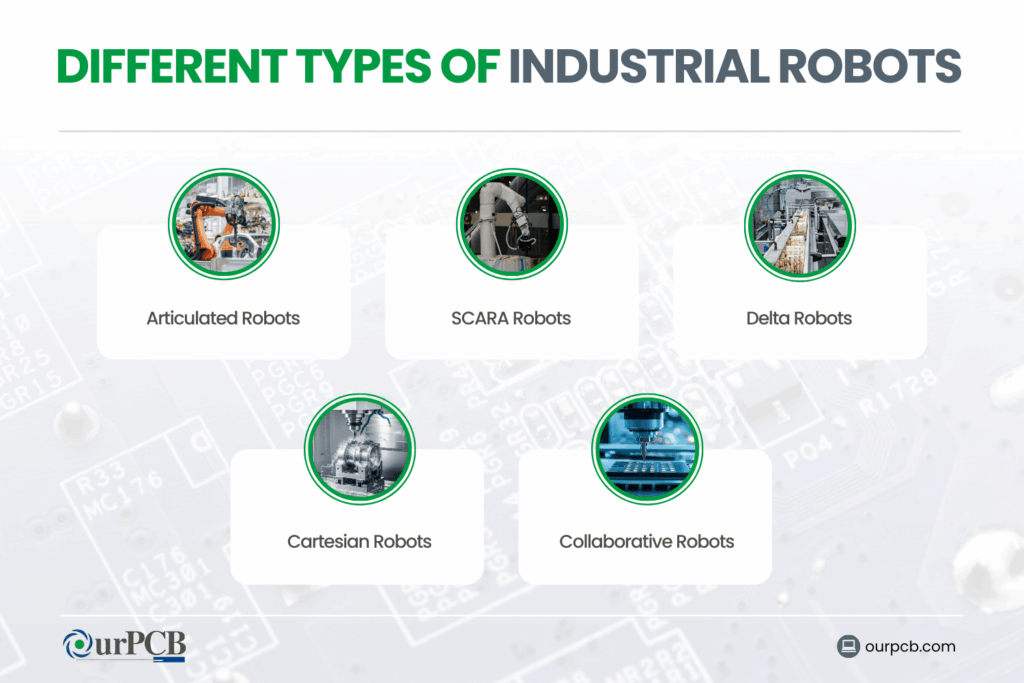
| Robot Type | Key Feature | Primary Use Cases | Typical Deployment |
|---|---|---|---|
| Articulated Robots | Jointed arms with high flexibility | Welding, assembly, painting | Automotive, heavy manufacturing |
| SCARA Robots | Horizontal motion optimized | Pick & place, precision assembly | Electronics, packaging |
| Delta Robots | High-speed parallel arm systems | Packaging & sorting | Food, pharmaceuticals |
| Cartesian Robots | Linear motion axes (X-Y-Z) | CNC machining, 3D printing | Precision cutting & milling |
| Collaborative Robots (Cobots) | Designed to work alongside humans | Small-scale automation | SMEs, flexible assembly |
Articulated Robots
Articulated robots are the most advanced industrial robots due to multi-axis motion, high payloads, and precision. They are widely used for welding, painting, sealing, and complex assembly tasks.
- Global industrial robot installations reached about 542,000 units in 2024.
- Installations are projected to reach around 575,000 units in 2025.
- Annual installations are expected to exceed 700,000 units before 2030.
A large share of this growth comes from articulated robot arms. The global industrial robot installation market across all robot types was valued at approximately US$16.7 billion entering 2026, while the articulated robot segment alone, covering robot arms, controllers, and integrated systems, is estimated to reach around US$37.6 billion in 2026 due to higher system complexity and average selling prices.
In 2026, sophisticated articulated robots integrate AI vision and edge inference for inspection and bin picking.
- Force and torque sensing enables compliant motion for polishing and precision insertion.
- Digital twins and offline programming reduce commissioning time and production downtime.
Demand for higher-payload and longer-reach robots is driven by EV batteries and large assembly lines.
SCARA Robots
SCARA robots are preferred for high-speed, repeatable precision in compact industrial environments. They are widely used in electronics assembly, machine tending, packaging, and laboratory workflows. SCARAs are especially effective for high-mix, small-part production with short cycle times.
A major market forecast projects the SCARA robot market at approximately US$14.78 billion by 2026. Growth is driven by demand for efficient automation with minimal factory floor space. In 2026, advanced SCARAs increasingly feature integrated vision systems and improved motion control.
Delta Robots
Delta robots are optimized for ultra-fast, repeatable pick-and-place with light payloads. They are commonly used in packaging, sorting, kitting, and food or pharmaceutical handling.
New data estimates delta robots growing at around 16.8% CAGR between 2024 and 2029. This growth is strongly driven by rising demand for automated packaging systems. Packaging robots overall are projected to grow from US$7.57B in 2025 to US$17.90B by 2032.
In 2026, sophisticated delta robots feature vision-guided picking on moving conveyors. Advanced grippers enable gentle handling through vacuum sensing and soft robotics. Fast changeovers support high SKU variability in e-commerce and retail-ready packaging.
Cartesian Robots
Cartesian robots excel in applications requiring straight-line accuracy, rigidity, and large, scalable work envelopes. They are commonly used for CNC machining, laser cutting, palletizing, dispensing, and large-area inspection systems. Estimates value the gantry and cartesian robot segment at about US$5.30 billion in 2024.
This segment is projected to grow toward approximately US$16.10 billion by 2032. Cartesian robots remain relevant due to their mechanical simplicity and high structural stability. They offer a cost-effective solution for large-format precision automation.
In 2026, cartesian robots are increasingly paired with machine vision and sensor feedback for automated measurement and inspection.
Collaborative Robots (Cobots)
Collaborative robots are designed to operate safely near humans with built-in safety features and simplified programming. They are ideal for SMEs and flexible production lines requiring rapid deployment and frequent task changes. Cobots accounted for approximately 11% of all industrial robot installations in 2023.
Market estimates value the collaborative robot segment at around US$4.03 billion in 2026. Shipment growth slowed to about 13.8% in 2024 due to delayed capital investment cycles. Analysts expect cobot demand to strengthen again from 2025 onward as automation investment resumes.
Special Offer: Get $100 off your order!
Email [email protected] to get started!
Global Robotics Market Value Explained
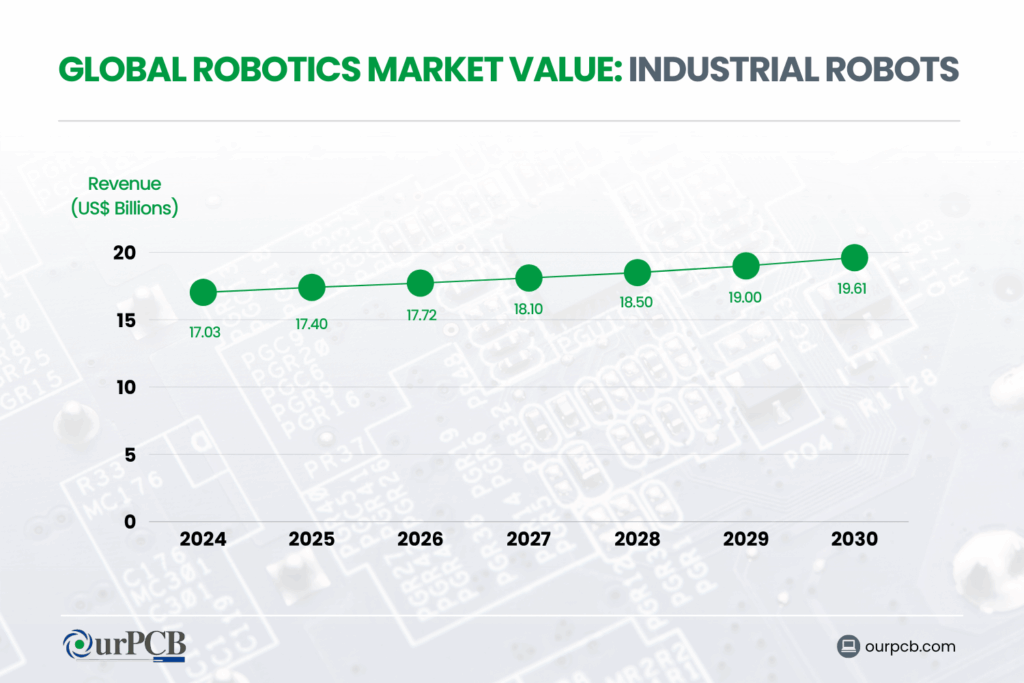
The global robotics industry is on a steep growth trajectory, though industry estimates can vary significantly.
- The overall global robotics industry size is projected to be around $50 billion in 2025 and grow to over $110 billion by 2030, reflecting strong annual growth.
- Specific industrial robotics estimates vary: analysts report values ranging from $20 – 87 billion in 2024, with forecasts doubling or tripling these figures by 2030 depending on definitions and segmentation.
- For industrial robots alone, data suggests a USD 21.94 billion market in 2025 growing to approximately USD 77.36 billion by 2034 at a strong pace.
These variations arise because different reports include broader automation systems, software, and service revenue in addition to hardware.
AI (Artificial Intelligence) is increasingly critical in robotics, enabling:
- Autonomous decision-making in unstructured environments
- Machine vision for quality inspection and navigation
- Smart planning and predictive maintenance
- Enhanced collaboration between robots and humans
The merging of AI with robotics is not just about motion — it's about learning from data, adapting behaviors, and optimizing productivity across dynamic environments.
What Parts are Needed to Make Industrial Robots?
An industrial robot is a marvel of electromechanical engineering. While the external arm is most visible, its performance relies on a network of critical internal components:
- Actuators and motors: Provide movement for joints and arms.
- Controllers and CPUs: Act as the robot’s brain, executing programmed paths.
- Sensors and vision systems: Detect surroundings, part placement, and more.
- Cables and Wire Harnesses: This is arguably the most critical and underappreciated component. High-quality, custom wire harnesses are essential for:
- Power distribution
- Signal transmission (from sensors and controllers)
- Safety interconnections
- End-effector tooling: Grippers, welders, or assembly tools tailored to tasks.
FAQs on Robotics Industry Statistics
What is industrial robot density?
Robot density measures the number of robots per 10,000 manufacturing employees. Worldwide averages continue to rise as automation spreads.
Are industrial robots safe?
Studies indicate automation can reduce some workplace injuries, but safety outcomes vary by industry, risk controls, and robot type.
Which companies drive the industrial robotics sector?
Key players include FANUC, KUKA, Universal Robots, ABB, and other automation leaders shaping production and AI-integrated robotics solutions.
OurPCB | Your Robotic Cable Assembly and Wire Harness Manufacturing Partner
As robotics systems grow more advanced and widespread, the statistics point to rising complexity, higher performance demands, and longer operating lifecycles. Behind every robot, reliable electronics and robust wiring are essential to power motion control, sensing, and safety systems.
With integrated and custom cable and wire harness manufacturing, and strict quality standards, OurPCB supports the electrical foundations that modern robotics depend on. We help OEMs build scalable, dependable automation systems ready for the years ahead.
Back to Top: Robotics Industry Statistics Growth, Trends & Key Data 2026
Special Offer: Get $100 off your order!
Email [email protected] to get started!