Electrical systems depend on secure, reliable connections between wires, components, and devices. These connections are made possible by wire harness connectors, which are purpose-built hardware that links wires to each other or to equipment while ensuring safe power and signal transmission.
This guide covers the essentials of wire harness connectors, exploring key categories, common applications, and critical considerations for selecting the right type for your design.
What are Wire Harness Connectors?
At their core, wire harness connectors are mechanical devices that join two or more electrical conductors together. They create a secure electrical and physical link between wires and components in a harness assembly. A connector typically has two parts:
- A male element (often called a plug); and
- A female element (often called a receptacle or socket)
These parts mate together to complete the connection.
What Purpose do Connectors Serve in a Wire Harness?
Connectors serve multiple functions in a wire harness:
- Transmit electrical power to devices and modules
- Carry signal data between control systems, sensors, and actuators
- Provide robust mechanical and environmental protection against vibration, moisture, and temperature
- Enable modular assembly and maintenance of complex electrical systems
Each connector type is designed with specific connection methods, contact arrangements, and mechanical features to suit particular performance, environment, and wiring requirements.
Why Wire Harness Connectors Matter
Connectors are far more than simple plugs:
- They ensure continuity and reliability in electrical systems where failures can be costly or dangerous
- They enable modularity, so wiring harnesses can be assembled, tested, and replaced with minimal disruption
- They support standardization, allowing components from different sources to interconnect while meeting safety and compliance standards
- They protect against environmental challenges, such as moisture, vibration, dust, and heat, all of which can degrade electrical systems over time
Understanding the range of connector types allows engineers, technicians, and hobbyists to choose solutions that balance ease of assembly, durability, electrical rating, and cost.
Special Offer: Get $100 off your order!
Email [email protected] to get started!
Broad Categories of Wire Harness Connectors
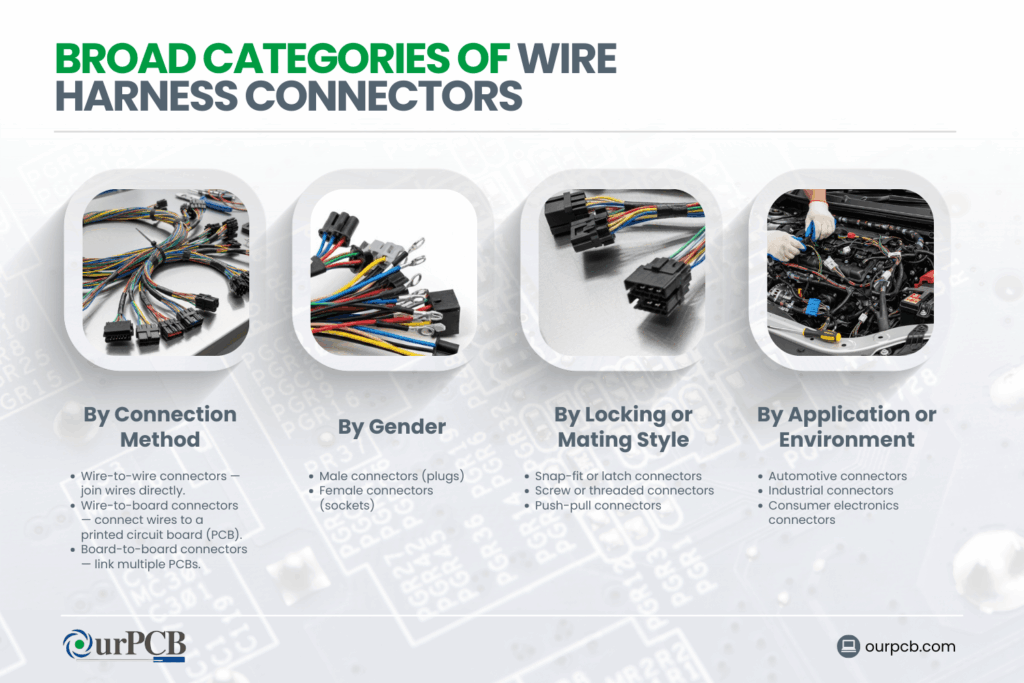
There are many ways to categorize wire harness connectors. Below is a helpful high-level breakdown before we dive into specific connector types:
1. By Connection Method
- Wire-to-wire connectors — join wires directly
- Wire-to-board connectors — connect wires to a printed circuit board (PCB)
- Board-to-board connectors — link multiple PCBs
2. By Gender
- Male connectors (plugs)
- Female connectors (sockets)
3. By Locking or Mating Style
- Snap-fit or latch connectors
- Screw or threaded connectors
- Push-pull connectors
4. By Application or Environment
- Automotive connectors
- Industrial connectors
- Consumer electronics connectors
These categories influence how connectors perform under real-world conditions, such as vibration resistance, waterproofing, and ease of service.
8 Most Common Types of Wire Harness Connectors
Below are the 8 most widely used types of wire harness connectors across industries and applications.
| Connector | Primary Use Case | Strength | Weakness |
|---|---|---|---|
| Blade Connectors (Fast-on / Spade) | Automotive wiring, appliances, industrial machinery | Easy installation, quick disconnect, cost-effective, good current capacity | Not inherently moisture-resistant without sealing |
| Pin & Socket Connectors | Automotive systems, aerospace, industrial controls | Strong vibration resistance, reliable for critical systems | Requires careful assembly and sealing in harsh environments |
| Butt Connectors / Inline Splice | Wire extensions and repairs | Simple, low-cost, easy repair solution | Non-detachable; mainly for fixed wiring |
| Crimp Connectors | Automotive, household wiring, industrial harnesses | High reliability when properly crimped, strong electrical contact | Requires proper tooling and quality control |
| Heat-Shrink Connectors | Harsh environments (moisture, chemicals, vibration) | Excellent sealing, strain relief, environmental protection | Requires heat tools for installation |
| Weather-Resistant Sealed Connectors | Under-hood automotive, heavy equipment, outdoor electronics | Highly resistant to water, dirt, and corrosion | Higher cost compared to basic connectors |
| Molex & Standardized Multi-Pin Connectors | Consumer electronics, computers, automotive wiring | Standardized, modular, keyed to prevent mis-mating | Not waterproof unless specifically sealed |
| Plug & Socket Connectors (General Purpose) | Consumer devices, appliances, automotive, machinery | Modular, widely available, easy assembly | Durability depends on design quality |
1. Blade Connectors (Fast-on / Spade Connectors)
Blade connectors use flat metal blades and mating receptacles to make the electrical link.
- Use case: Automotive wiring, appliances, industrial machinery
- Strengths: Easy installation, quick disconnect, good current capacity
- Weaknesses: Not always protected against moisture without additional sealing
Blade connectors often come as quick-disconnect (QD) terminals where the male and female parts slide together and lock with friction. They are among the most common connector types due to ease of use and cost-effectiveness.
2. Pin & Socket Connectors
Pin and socket connectors use cylindrical pins (male) that fit into corresponding sockets (female) inside a connector housing.
- Use case: Automotive systems, aerospace, industrial controls
- Strengths: Good vibration resistance; reliable performance in critical systems
- Weaknesses: Often require careful assembly and sealing for harsh environments
These are among the primary types of connectors used when precision and resistance to vibration are priorities. They can appear as single-pin or multi-pin configurations for many circuits.
3. Butt Connectors / Inline Splice Connectors
Butt connectors allow two wires to be joined end-to-end within the harness.
- Use case: Wire extensions and repair
- Strengths: Simple and low-cost
- Weaknesses: Typically not detachable; mainly used in fixed wiring
Butt connectors are especially common in automotive repairs and retrofits. They are crimped onto each wire end and sealed to keep a secure connection.
4. Crimp Connectors
Crimp connectors secure the wire by deforming a metal sleeve around its stripped end with a crimping tool.
- Use case: Automotive, household wiring, industrial harnesses
- Strengths: High reliability when crimped properly; excellent electrical contact
- Weaknesses: Requires proper tooling and quality control
Crimp connectors can take several forms, such as bullet connectors, ring terminals, and spade terminals. Because of their mechanical strength and conductivity, they are among the most common termination methods used in harness assemblies.
5. Heat-Shrink Connectors
These connectors combine a crimped connection with heat-shrink insulation to provide additional environmental protection.
- Use case: Harsh environments exposed to moisture, chemicals, or vibration
- Strengths: Excellent sealing and strain relief
- Weaknesses: Requires heat application tools
Heat-shrink connectors are common in outdoor equipment, automotive engine compartments, and marine applications where exposure can compromise an unsecured joint.
6. Weather-Resistant Sealed Connectors
Some harness connectors — like Weather Pack or Deutsch connectors — are designed specifically to resist water, dirt, and corrosion.
- Use case: Automotive under-hood systems, heavy equipment, outdoor electronics
- Strengths: Highly resilient against environmental factors
- Weaknesses: Higher cost than basic connector types
These connectors are invaluable when reliability in extreme conditions is non-negotiable. Many OEM automotive harnesses use these sealed systems.
7. Molex & Standardized Multi-Pin Connectors
Molex connectors are two-piece pin-and-socket connectors that support multiple circuits.
- Use case: Consumer electronics, computers, automotive wiring
- Strengths: Standardized, versatile, reliable
- Weaknesses: Not always waterproof without additional sealing
Molex connector families are used in many industries because they support modular harness designs and can be easily integrated into wire-to-board and board-to-wire configurations. Their rectangular housings and keyed orientations prevent incorrect insertion.
8. Plug & Socket Connectors
Often referred to simply as plugs and receptacles, these connectors form the backbone of most wire harness systems.
- Use case: General electrical interconnections in consumer devices, appliances, automotive, and machinery
- Strengths: Modular, easy to assemble, widely available
- Weaknesses: Varying levels of durability depending on design
How to Choose the Right Type of Wire Harness Connector
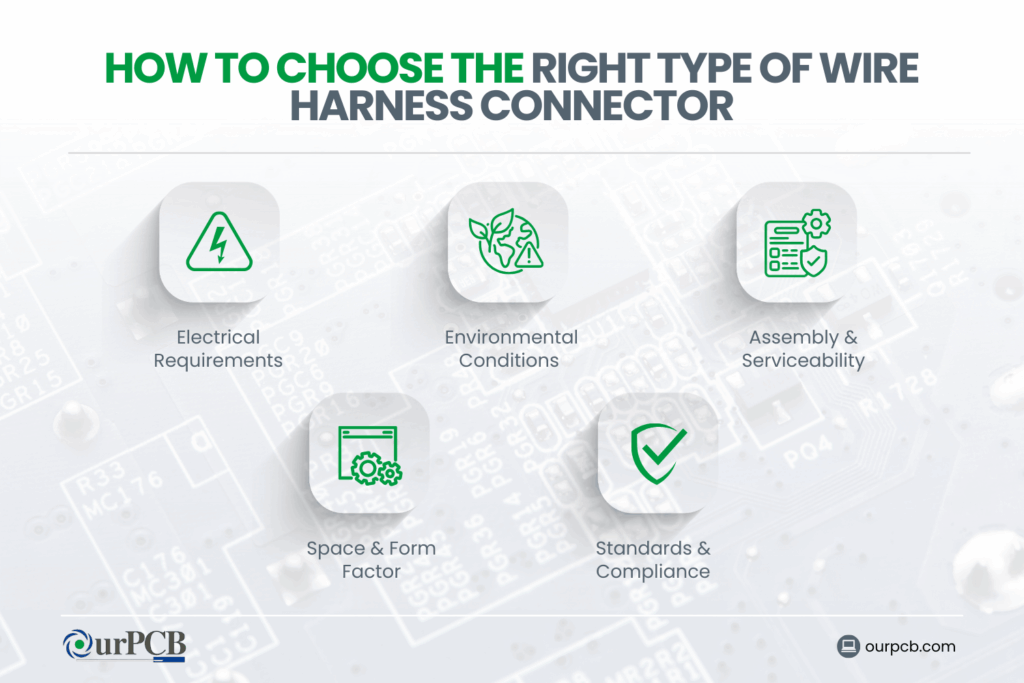
Choosing from the different types of wire harness connectors isn’t just about picking a shape that fits, it’s about matching the connector to the electrical, environmental, and mechanical demands of your application. Consider:
1. Electrical Requirements
When selecting a wire harness connector, start by evaluating the electrical requirements. The connector must support the system’s voltage rating to prevent insulation breakdown or failure. It also needs an appropriate current rating to safely handle the expected load without overheating. Finally, consider the signal type, whether the connection carries power, data, or a combination of both, as different signal requirements influence contact design, shielding, and overall connector selection.
2. Environmental Conditions
Environmental conditions play a critical role in connector selection. You must consider whether the harness will be exposed to moisture or direct water contact, which may require sealed or weather-resistant designs. Temperature extremes can affect insulation materials and contact performance, so connectors must be rated accordingly. Additionally, environments with vibration or mechanical shock demand connectors that provide secure locking mechanisms and strong contact retention to prevent intermittent failures.
3. Assembly & Serviceability
Assembly and serviceability are also important considerations in connector selection. The connector should allow for easy and efficient installation to reduce assembly time and errors. It should also be designed for convenient disconnection if maintenance or repairs are required, especially in systems that need periodic servicing. Finally, ensure that compatible mating parts are readily available to avoid supply delays and long-term service challenges.
4. Space & Form Factor
Space and form factor constraints must be evaluated early in the design process. The available room for connectors will determine overall size, housing style, and wire routing options. In compact assemblies, right-angle or low-profile connectors may be required to optimize space usage and prevent interference with adjacent components. Proper form factor selection ensures reliable integration without compromising performance or service access.
5. Standards & Compliance
Standards and compliance should always be verified before finalizing connector selection. The connector must meet relevant industry standards and safety ratings to ensure regulatory compliance, product reliability, and market acceptance.
Selecting the appropriate connector can improve harness longevity, reduce failure risk, and simplify assembly and maintenance workflows.
Conclusion
Connectors may be small, but they are fundamental to the reliability, safety, and performance of any electrical system that uses a wire harness. Whether you’re building automotive wiring systems, industrial control assemblies, consumer electronics, or custom harness solutions, understanding types of wire harness connectors empowers you to design smarter, safer, and more efficient electrical systems.
If you’d like help specifying connectors for your next wire harness project, let OurPCB know!
Different Types of Wire Harness Connectors FAQs
What is the difference between a connector and a terminal in a wire harness?
A terminal is the conductive metal contact that attaches directly to a wire, usually by crimping or soldering. A connector is the complete assembly that houses one or more terminals and allows them to mate with a corresponding connector. In simple terms, terminals carry the electrical current, while connectors provide the structured interface and protection.
How do I determine the correct wire gauge for a connector?
The connector must match the wire gauge (AWG or mm²) being used. Manufacturers provide specifications indicating compatible wire sizes. Selecting the wrong size can lead to weak crimps, overheating, or unreliable electrical contact.
What is IP rating, and why does it matter for connectors?
An IP (Ingress Protection) rating defines how well a connector resists dust and water. For example, IP67 connectors are protected against dust and temporary immersion in water. In outdoor, automotive, or industrial environments, selecting the correct IP rating is critical to long-term reliability.
Back to Top: Different Types of Wire Harness Connectors | Guide 2026
Special Offer: Get $100 off your order!
Email [email protected] to get started!